Tree Planting Rules and Native Species Guide for Dripping Springs
Tree planting in Dripping Springs has become more than just a landscaping decision—it's a careful balance between honoring strict environmental regulations, respecting our Central Texas climate, and creating outdoor spaces that work for your family or business. After more than 20 years in construction and land development across different environments, I've learned that successful tree planting starts with understanding what you're working with and what you're working toward. In Dripping Springs, that means navigating a detailed set of rules designed to protect the Hill Country character while dealing with real water scarcity challenges. At Earth in Motion, we help property owners and developers get trees in the ground the right way—trees that will thrive for decades, meet local requirements, and add genuine value to your land.
Why Tree Preservation Rules Matter in Dripping Springs
Dripping Springs adopted a comprehensive landscape and tree preservation ordinance that fundamentally changed how property owners approach tree planting and removal. The city didn't create these rules to make your life difficult. They exist because Central Texas lost too many mature native trees to development over the past few decades, and those trees took 50, 75, even 100 years to grow. Once they're gone, you can't get that ecological function back in your lifetime.
The ordinance divides trees into two categories based on their size and species. Heritage Trees are the big ones—18 inches or more in diameter measured at a specific height from the ground. These are your mature Live Oaks, Cedar Elms, and other native species that define the Hill Country landscape. Standard Trees fall between 8 and 18 inches in diameter. The city treats these two categories very differently when it comes to removal and protection.
Here's what you need to understand about Heritage Trees: you generally cannot remove them unless they're dead, diseased beyond saving, or pose an immediate safety hazard. Even then, you'll need documentation from a certified arborist proving the tree meets one of those exceptions. I've seen developers come into projects without understanding this requirement, only to realize their entire site plan needs to be redesigned around a cluster of protected oaks. That's an expensive lesson to learn after the fact.
Standard Trees have more flexibility, especially on individual residential lots outside of major development projects. But during subdivision development or commercial construction, these trees face removal restrictions too. The underlying principle is simple: preserve what took decades to establish, and when removal is unavoidable, replace what you take.
Understanding Mitigation Requirements When Trees Must Go
Sometimes tree removal is genuinely necessary—maybe the tree is diseased, or its location makes construction impossible without compromising the building's foundation or utility lines. When you must remove a Heritage Tree, the city requires you to plant three new trees for every one you take down. That's a 3:1 replacement ratio. For Standard Trees, it's 1:1.
These replacement trees can't be just anything. They must be native or adapted species appropriate for Central Texas conditions, and they must meet minimum size requirements—typically a 2.5-inch caliper for shade trees, measured six inches above ground level. The tree also needs to be at least eight feet tall at planting. You're also responsible for maintaining these trees and replacing any that die within five years. That's a long-term commitment, not a one-time checkbox.
In some cases, on-site replacement isn't practical. Maybe your lot is too small, or you've already maximized your tree planting areas. The city allows you to pay a fee instead, which funds tree planting elsewhere in the community. The Development Review Committee determines these fees case-by-case. I've worked with clients who pursued this route when the property layout genuinely couldn't support the required number of trees without creating maintenance nightmares or compromising other site functions.
Selecting the Right Trees for Central Texas Conditions
Not all trees will thrive in Dripping Springs, and the city knows this. That's why the ordinance requires native or adapted species that match our soil, climate, and water availability. This isn't about limiting your choices—it's about ensuring the trees you plant actually survive and contribute to the local ecosystem rather than becoming expensive liabilities that die in three years.
Central Texas soil varies dramatically even within small areas. You might have shallow rocky soil on one part of your property and deeper clay loam 50 feet away. Native trees evolved to handle this variability. Live Oak, Cedar Elm, Texas Red Oak, Texas Redbud, Mexican Plum, and Texas Persimmon are all excellent choices because they've adapted to our alkaline soils and drought cycles over thousands of years. They develop deep root systems that help them survive extended dry periods without constant irrigation.
I've worked on projects across different climates—from Colorado to Central Texas—and one universal truth holds: trying to force a tree into an environment it's not suited for never ends well. In Colorado, you plant for cold hardiness and snow load. In Texas, you plant for heat tolerance and water efficiency. When clients ask me about ornamental species from other regions, I explain that while those trees might look attractive in a nursery, they'll struggle here without intensive care, frequent watering, and often additional soil amendments. That's not sustainable, and it's not what Dripping Springs regulations encourage.
How Soil Type and Sun Exposure Drive Your Tree Selection
Before we plant anything, I always evaluate the soil and sun exposure across your property. Some areas might have full sun all day, while others get afternoon shade from existing structures or established trees. This information determines which species go where.
Live Oaks handle full sun beautifully and provide excellent shade once mature. They're also somewhat drought-tolerant once established, though they'll look better with occasional deep watering during severe droughts. Cedar Elm grows faster than many people realize and tolerates both sun and partial shade. Texas Redbud works well as an understory tree and provides gorgeous spring color before its leaves emerge.
Soil depth matters too. Shallow rocky soil limits your options but doesn't eliminate them—many native species actually prefer these conditions. If you're working with deeper soil, you have more flexibility. I've learned through experience that trying to amend soil extensively to accommodate non-native species rarely works long-term. It's far better to match the tree to your existing conditions than to fight nature indefinitely.
Meeting Street Tree Requirements and Placement Rules
The city doesn't just care about preserving existing trees—it also requires you to plant new trees as part of development. Residential lots typically need one or two street trees depending on lot size and zoning. Commercial properties must plant one tree for every 25 feet of street frontage. These requirements ensure that neighborhoods maintain tree canopy coverage and visual appeal as they develop.
Street tree placement has specific rules you must follow. Trees cannot go within 15 feet of electrical or telecommunications lines. That's a safety issue—you don't want branches interfering with power lines or service connections. Trees also can't be planted within water or wastewater easements. These easements provide access for utility maintenance, and tree roots can damage underground infrastructure. Some species with particularly aggressive root systems are prohibited near roadways entirely because they'll eventually buckle pavement or penetrate pipes.
At Earth in Motion, we handle these placement calculations during the planning phase. I've seen too many projects where trees got planted in convenient locations rather than compliant ones, leading to expensive relocations later. Sometimes the property owner doesn't realize there's an underground easement running through that perfect planting spot. We identify these conflicts upfront by reviewing survey documents and utility maps before we start digging.
Can Existing Trees Count Toward Your Requirements?
Yes, but only if they meet specific standards. Your existing trees must be the right size (minimum caliper requirements), in good health, and positioned appropriately relative to streets and property lines. A healthy mature oak in your front yard might satisfy your street tree requirement if it's located correctly. We document these trees as part of your landscape plan submission to ensure they're credited properly.
This is where a thorough tree survey becomes valuable. For larger developments—anything with five or more residential units, or commercial and institutional projects—you'll need a licensed surveyor to document all protected trees eight inches in diameter and larger. That survey shows exactly what you're working with and helps identify preservation opportunities that reduce your mitigation obligations.
Water Restrictions and Drought-Tolerant Landscaping Strategies
Here's the reality nobody wants to talk about but everyone needs to understand: water scarcity is the defining challenge for landscaping in Dripping Springs. The city currently operates under Stage 4 drought restrictions, which are the most severe level. Under Stage 4, you can only water with a hand-held hose or drip irrigation system, one day per week, during specific hours—either early morning or evening. Automatic sprinkler systems are prohibited entirely.
These restrictions create a genuine problem for newly planted trees. Young trees need consistent moisture during their first growing season to establish root systems. Without that establishment period, survival rates drop dramatically. But you can't run sprinklers every other day like you might want to. So how do you keep new trees alive without violating water restrictions?
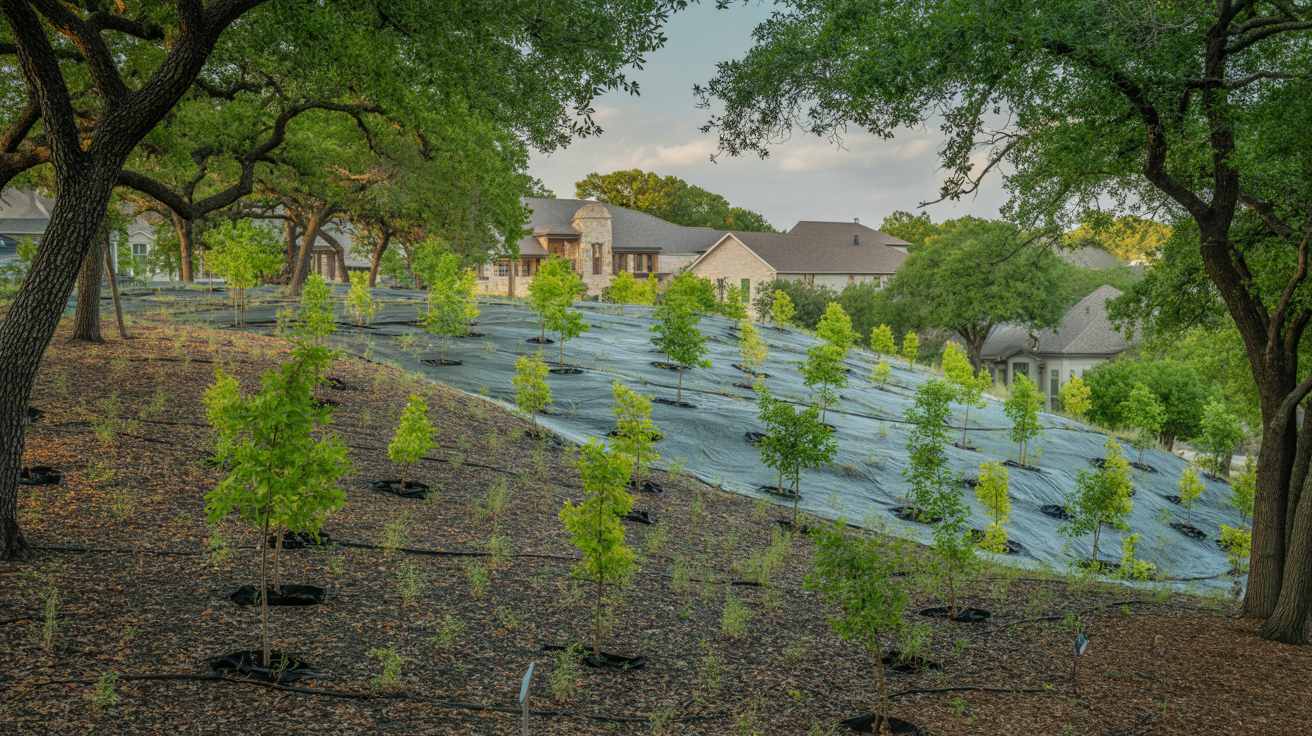
The answer is drip irrigation combined with smart species selection and proper mulching techniques. Drip irrigation delivers water directly to the root zone with minimal evaporation or runoff. It's far more efficient than broadcast sprinklers, and it's allowed under current restrictions. The city actively encourages drip irrigation through the ordinance, even offering pathways for variances if you commit to drought-tolerant species and point-source irrigation.
Why Native Trees Survive When Others Fail
Native trees have a massive advantage during drought because they evolved here. Their root systems grow deeper, searching for moisture below the surface. They've adapted to survive Central Texas summers with minimal rainfall. A mature Live Oak might go months without supplemental water once established and show no stress. Try that with a non-native ornamental from a wetter climate, and you'll watch it decline rapidly.
During establishment—roughly the first two years after planting—even native trees need help. But we're talking about weekly deep watering during dry periods, not daily irrigation. We establish a watering schedule that complies with restrictions while giving the tree what it needs. A thick mulch layer around the base—keeping it away from the trunk to prevent rot—conserves moisture and moderates soil temperature.
I've watched this approach work across dozens of projects. The clients who select appropriate native species and commit to sensible establishment care end up with healthy, thriving trees that require minimal maintenance long-term. The clients who insist on species that aren't suited to the climate spend years fighting a losing battle with irrigation bills and tree replacement costs.
Commercial Development and Parking Area Landscaping
Commercial projects face additional requirements beyond basic street tree planting. The ordinance mandates that parking areas include landscaped islands at a specific ratio—one tree for every six parking spaces. These aren't just decorative features. They provide shade that cools the pavement, reduces heat island effects, and creates a more pleasant environment for customers and employees.
The islands themselves must meet size standards and include proper curbing unless you're using low-impact development techniques that capture runoff for irrigation. Plant selection matters here too—you need trees that won't interfere with sight lines for vehicle traffic but still provide meaningful canopy coverage. We typically use species that develop spreading canopies without excessive height, and we ensure proper spacing so the trees have room to reach mature size without crowding.
Screening requirements also apply to refuse containers and mechanical equipment. The city requires specific plant types and densities to minimize visual impact. These aren't suggestions—they're enforceable standards that get checked during inspection. I've worked with commercial developers who tried to shortcut these requirements and ended up delaying their certificate of occupancy because the landscaping didn't meet code.
Landscape Buffers Between Property Types
When commercial property abuts residential areas, landscape buffers become mandatory. These buffers create visual separation and reduce noise and light impacts on neighboring homes. The ordinance specifies minimum buffer widths, plant densities, and tree spacing to ensure these buffers actually function as intended rather than being token plantings.
Buffer design requires understanding both aesthetics and ecology. We layer plants at different heights—groundcovers, shrubs, understory trees, and canopy trees—to create depth and year-round coverage. Native species work best because they support local wildlife while requiring less maintenance. A well-designed buffer enhances property values on both sides of the property line.
How We Plan Tree Planting Projects at Earth in Motion
Every successful tree planting project starts with thorough planning, not with a shovel in the ground. At Earth in Motion, we begin by evaluating your property conditions, understanding your goals, and reviewing the regulatory requirements that apply to your situation. That evaluation tells us what's possible, what's required, and what obstacles we need to work around.
For larger projects requiring formal landscape plans and tree surveys, we coordinate with licensed professionals to ensure documentation meets city standards. These plans aren't bureaucratic paperwork—they're roadmaps that prevent expensive mistakes during construction. They identify preservation opportunities, show compliant tree placement, specify appropriate species, and demonstrate how irrigation will be handled.
Timing matters too. We don't plant during the hottest part of summer if we can avoid it, because establishment stress is brutal even with irrigation. Fall planting gives trees several months of moderate weather to develop roots before facing their first Texas summer. Spring planting works too, but it requires more attentive watering through the heat.
Addressing Site-Specific Challenges
No two properties are identical, and each one presents unique challenges. Maybe you have significant grade changes that affect drainage and root development. Maybe there's existing infrastructure that limits where trees can go. Maybe the soil is heavily compacted from previous construction activity and needs remediation before planting will succeed.
I've learned from two decades of construction work that identifying these issues upfront prevents problems later. We test soil conditions, evaluate drainage patterns, and locate underground utilities before finalizing planting locations. If compaction is severe, we address it through deep tilling or other techniques to ensure roots can penetrate and spread. If drainage is poor, we adjust grading or select species that tolerate periodic standing water.
These details might seem minor, but they determine whether your trees thrive or struggle. A tree planted in a low spot where water collects might develop root rot. A tree planted in heavily compacted soil might never establish a healthy root system and will remain stunted. Getting these fundamentals right is what separates successful projects from ones that require expensive corrective work.
Long-Term Maintenance and Your Responsibilities
Tree planting isn't a one-time event—it's the beginning of a long-term relationship with those plants. The ordinance requires property owners to maintain trees according to ANSI standards and replace any tree that dies or becomes diseased beyond repair within five years. That's your responsibility, whether you planted the tree yourself or we installed it for you.
Proper maintenance means appropriate watering during establishment, mulching to conserve moisture and control weeds, and monitoring for pest or disease problems. It means not piling soil or construction materials over root zones during other projects on your property. It means avoiding excessive pruning or "topping" that damages tree structure and creates long-term health problems.
Native trees require far less maintenance than non-native species once established, but they're not zero-maintenance. You'll need to water during severe droughts even after the establishment period. You might need to prune dead branches or address structural issues as the tree matures. These are normal aspects of tree stewardship, not failures or defects.
What Happens When Trees Fail Despite Good Care
Sometimes trees die even when you do everything right. Disease, pest infestations, or severe weather events can kill trees that were previously healthy. When this happens within the five-year window, you're required to replace the tree. The replacement must meet the same species and size standards as the original planting.
This requirement protects the city's tree canopy goals and ensures properties maintain the minimum vegetation coverage intended by the ordinance. It's not a punishment—it's an acknowledgment that trees are living organisms with mortality risk, and the community's environmental goals require consistent replacement when losses occur.
Why Professional Planning Matters for Tree Planting Success
You might be wondering whether you really need professional help to plant some trees. It's a fair question, especially for simple residential projects. But here's what I've learned: the gap between "putting a tree in the ground" and "establishing a healthy tree that meets all requirements and thrives long-term" is bigger than most people realize.
Professional planning accounts for factors you might not consider. We evaluate soil pH and structure. We consider mature tree size relative to buildings and utilities. We ensure species selection matches your site conditions and maintenance capacity. We handle regulatory compliance so you don't discover violations months or years later. We coordinate irrigation installation to support establishment without violating water restrictions.
The cost of doing it wrong the first time almost always exceeds the cost of doing it right from the start. A tree that dies because it was poorly sited or received inadequate establishment care must be replaced—and you've lost years of growth in the process. A tree planted in violation of utility clearance rules might need to be relocated. A project that doesn't meet ordinance requirements won't pass inspection, delaying your certificate of occupancy or creating enforcement issues down the road.
How Our Experience Across Different Environments Benefits Your Project
My background includes construction work across different climates and soil conditions, from Colorado to Central Texas. That diversity of experience helps me anticipate how site conditions will affect tree success. I've seen what happens when people apply landscaping approaches that worked in other regions to Central Texas—it usually doesn't go well.
At Earth in Motion, we've developed systems and processes refined through hundreds of projects. We know which native species perform reliably and which ones are finicky. We know how to evaluate soil and drainage quickly. We understand the regulatory landscape and how to navigate the approval process efficiently. We maintain relationships with quality nurseries that provide healthy, properly-grown stock rather than stressed plants that struggle after installation.
This accumulated knowledge means your project benefits from lessons learned on previous sites. We won't experiment with your property or treat your landscape as a training exercise. We apply proven approaches adapted to your specific conditions, requirements, and goals.
Creating Value Through Strategic Tree Placement and Species Selection
Well-planned tree planting isn't just about meeting regulations—it's about creating genuine value for your property. Mature trees increase property values, reduce energy costs through shading, create wildlife habitat, and establish the visual character of your landscape for decades.
Strategic placement means thinking about how trees will function once they reach mature size. A shade tree on the west side of your home reduces afternoon heat gain, lowering cooling costs. Trees positioned to frame views or define outdoor spaces enhance aesthetic appeal without blocking important sight lines. Species with seasonal interest—flowers in spring, fall color, attractive bark—provide year-round visual value.
Native trees support local wildlife by providing food sources and habitat. Birds, butterflies, and beneficial insects all rely on native plants because they evolved together. A landscape built around native trees becomes part of the ecological web rather than a sterile ornamental display requiring constant chemical inputs to maintain.
Balancing Immediate Impact with Long-Term Vision
Clients often want mature-looking landscapes immediately, which is understandable. But trying to plant trees that are too large increases transplant stress and reduces survival rates. Larger trees are more expensive, require more intensive establishment care, and actually take longer to resume active growth than properly-sized younger trees.
We help clients understand the growth timeline so they can set realistic expectations. A 2.5-inch caliper shade tree might look modest at planting, but with proper care, it will add significant size each year. In five years, you'll have a meaningful tree. In ten years, it will provide substantial shade and visual presence. That's actually faster overall success than planting a much larger tree that struggles for several years before recovering from transplant shock.
Final Thoughts on Successful Tree Planting in Dripping Springs
The regulations governing tree preservation and planting in Dripping Springs reflect the community's commitment to maintaining its Hill Country character while managing growth pressures and water scarcity. These rules might seem complex, but their underlying goals are straightforward: protect what took decades to establish, ensure new plantings use appropriate species, and conserve water through efficient irrigation practices.
Success requires understanding the regulatory framework, selecting species suited to your conditions, planning placement carefully to avoid conflicts with utilities and structures, and committing to proper establishment care during the critical first years. At Earth in Motion, we guide clients through this process with the practical knowledge gained from over 20 years of construction and land development experience across different environments.
Whether you're planting a couple of street trees for a new home, developing a subdivision, or creating a commercial landscape, the fundamentals remain the same: work with nature rather than against it, choose native and adapted species that thrive here, plan for long-term success rather than short-term appearance, and meet regulatory requirements from the start rather than fixing problems later. If you approach tree planting in Dripping Springs with these principles in mind, you'll create landscapes that enhance your property, support the local ecosystem, and satisfy the community's environmental goals for generations to come.
Frequently Asked Questions About Tree Planting in Dripping Springs
What types of trees should I plant on my Dripping Springs property to comply with local regulations?
At Earth in Motion, we focus exclusively on native and adapted species that thrive in Central Texas conditions while meeting Dripping Springs ordinance requirements. Live Oak, Cedar Elm, Texas Red Oak, Texas Redbud, Mexican Plum, and Texas Persimmon are excellent choices because they've evolved to handle our alkaline soils and drought cycles. These trees develop deep root systems that survive extended dry periods without constant irrigation, which is crucial given our Stage 4 drought restrictions. I evaluate your specific soil conditions and sun exposure patterns to recommend the right species for each location on your property. The key is matching trees to your existing conditions rather than fighting nature with inappropriate species that will struggle and require expensive maintenance.
How do I meet street tree requirements without violating utility clearance rules?
This is one of the most common placement challenges I solve for clients in Dripping Springs. Trees cannot be planted within 15 feet of electrical or telecommunications lines, and they're prohibited in water or wastewater easements. At Earth in Motion, I handle these placement calculations during the planning phase by reviewing survey documents and utility maps before we start digging. I identify conflicts upfront that prevent expensive relocations later. For residential lots needing one or two street trees, and commercial properties requiring one tree per 25 feet of street frontage, I find compliant locations that satisfy both the ordinance requirements and safety clearances. Sometimes this means adjusting your preferred planting spots, but proper planning ensures your trees enhance your property without creating future utility conflicts.
What happens if I need to remove a Heritage Tree, and how do mitigation requirements work?
Heritage Trees—those 18 inches or larger in diameter—generally cannot be removed unless they're dead, diseased beyond saving, or pose immediate safety hazards. When removal is genuinely necessary and properly documented, Dripping Springs requires a 3:1 replacement ratio. At Earth in Motion, I help clients navigate this process by coordinating with certified arborists for proper documentation and planning compliant replacement strategies. The new trees must be native or adapted species meeting minimum size requirements—typically 2.5-inch caliper and eight feet tall. You're responsible for maintaining these trees and replacing any that die within five years. When on-site replacement isn't practical due to space limitations, I work with clients to explore fee-in-lieu options that fund community tree planting elsewhere.
How can I successfully establish new trees while complying with Stage 4 drought restrictions?
Water restrictions create genuine challenges for tree establishment, but I've developed proven strategies that work within current limitations. At Earth in Motion, I install drip irrigation systems that deliver water directly to root zones with minimal waste—these systems are allowed under Stage 4 restrictions and actively encouraged by the city. Native species selection is crucial because these trees need far less establishment water than non-native alternatives. I combine weekly deep watering schedules that comply with restrictions, proper mulching techniques to conserve moisture, and timing installations for fall or early spring to avoid the worst summer stress. This approach gives trees what they need during the critical first two years while respecting water conservation requirements. The clients who follow this system end up with healthy, thriving trees that require minimal long-term irrigation.
What factors determine the cost of a compliant tree planting project in Dripping Springs?
Several key factors drive project costs, and I help clients understand these variables during planning at Earth in Motion. Site conditions significantly impact cost—shallow rocky soil requires different techniques than deep clay, and poor drainage might need remediation before planting succeeds. The number of trees required depends on your development type and size, with residential lots typically needing one or two street trees while commercial properties require more extensive planting. Species selection affects both material and long-term maintenance costs, though native trees typically offer better value over time. Regulatory requirements like tree surveys for larger developments, formal landscape plan preparation, and mitigation obligations for protected tree removal add to project complexity. Installation timing, irrigation system needs, and site accessibility also influence final costs. I evaluate these factors during initial assessment to provide realistic expectations and identify opportunities to optimize both compliance and budget.
Hire Us