Cedar Park Tree Planting Guide: Rules, Species & Tips
Tree planting in Cedar Park isn't just about digging a hole and dropping a sapling into the ground—it's a long-term investment in your property, your neighborhood, and the entire Central Texas ecosystem. I'm Chad Burnell, founder of Earth in Motion, Inc., and after more than 20 years of hands-on construction and land management work across Texas and beyond, I've learned that getting trees into the ground the right way means understanding local regulations, selecting species that thrive in our challenging climate, and committing to proper care from day one. In this article, I'm going to walk you through everything you need to know to make smart decisions about planting trees on your Cedar Park property, whether you're a homeowner looking to add shade and curb appeal or a developer navigating city requirements.
Why Tree Planting in Cedar Park Matters More Than You Think
When I first started working in Central Texas back in the early 2000s, I quickly realized that this region doesn't make it easy on trees. We've got alkaline soils that many species can't tolerate, brutal summer heat, unpredictable rainfall patterns, and a growing population that puts pressure on our urban forest. But here's the thing: trees are one of the best investments you can make in your property and your community. They provide shade that cuts your cooling costs, increase property values, filter stormwater runoff, improve air quality, and create habitat for wildlife. When you plant a tree correctly and care for it properly, you're setting up decades of benefits that compound over time.
Cedar Park has recognized this value, which is why the city has established detailed requirements and guidelines for tree planting. These regulations aren't just bureaucratic red tape—they're designed to ensure that our community's tree canopy continues to grow and provide those environmental benefits for future generations. Whether you're building a new home, developing a commercial property, or simply want to improve your existing landscape, understanding these rules will save you time, money, and frustration down the road.
The Current State of Cedar Park's Urban Forest
Before we dive into how to plant trees, it helps to understand where Cedar Park stands today. The city maintains thousands of public trees along streets and in medians, but the current inventory shows that we're only using about 65 percent of available planting sites. That means there's significant room for expansion. The dominant species you'll see around town are live oak and cedar elm, which together make up more than half of the public tree population. While these are excellent, hardy trees well-suited to our conditions, this lack of diversity creates vulnerability to pests and diseases. If a single pathogen targets live oaks, for example, it could devastate a huge portion of our urban canopy.
This is where strategic tree planting comes into play. By choosing a wider variety of native and well-adapted species, property owners can help build a more resilient urban forest that can withstand whatever challenges climate change and invasive pests throw our way. I've seen this principle at work across all kinds of projects—from residential lots to large-scale developments—and the communities that embrace diversity always come out stronger.
Navigating Cedar Park's Tree Planting Requirements
If you're developing property or making significant changes to your landscape in Cedar Park, you need to understand the city's minimum planting requirements. These rules apply to both residential and commercial projects, and they're enforced to ensure that new development contributes positively to the community's green infrastructure rather than depleting it.
Basic Planting Standards for New Development
The baseline requirement is straightforward: for every 1,000 square feet of required landscaping area, you must plant at least one tree and three five-gallon shrubs. Now, that might not sound like much, but it adds up quickly on larger properties. The city also requires buffer yards between different land uses—meaning if your commercial property backs up to a residential neighborhood, you'll need more substantial landscaping to provide visual screening and noise reduction. These buffer zones might require additional trees, larger specimens, or specific arrangements to meet the intent of the ordinance.
Over my years working with Earth in Motion, I've helped countless clients navigate these requirements. The key is to plan early. Too many property owners wait until the last minute, then scramble to meet the minimums with whatever plants are cheaply available at the big-box store. That approach might get you through inspection, but it doesn't set you up for long-term success. Those bargain trees often struggle in our soils, require excessive maintenance, or fail to thrive and need replacement within a few years. It's far smarter to invest in quality specimens and proper installation from the start.
Tree Surveys and Preservation Plans
If you have existing trees on your property with a trunk diameter over 8 inches, Cedar Park may require a tree survey and preservation plan before you can proceed with development. This regulation recognizes the value of mature trees and aims to protect them whenever feasible. From a practical standpoint, working around existing trees can be challenging—their root zones extend far beyond the drip line, and construction activity can easily damage or kill a tree even if you never touch the trunk.
I've managed many projects where preserving existing trees made sense both aesthetically and financially. A mature tree can add thousands of dollars to property value and provides immediate shade and screening that newly planted trees won't match for decades. But I've also seen situations where the cost and complexity of protecting trees during construction outweighed the benefits. Each site is unique, and the decision should be based on the specific conditions, the health and quality of the existing trees, and the overall project goals. At Earth in Motion, we approach these decisions with a practical eye—we're not looking to cut down trees unnecessarily, but we're also not going to waste your money on heroic efforts to save trees that are already declining or poorly located for the new use.
Choosing Species That Will Actually Thrive in Cedar Park
This is where a lot of tree planting projects go wrong. People fall in love with a particular species they saw somewhere else, or they choose based solely on aesthetics without considering whether that tree is suited to Central Texas conditions. I can't tell you how many times I've been called out to diagnose why someone's tree is struggling, only to find that it's a species that simply doesn't belong here.
Native and Well-Adapted Shade Trees
Cedar Park provides a list of approved species that are proven performers in this region. The big shade trees—your live oak, cedar elm, pecan, Texas ash, and various other oak species—form the backbone of a healthy urban forest. These trees can handle our alkaline soils, tolerate drought once established, and provide substantial canopy coverage. Live oak is probably the most iconic Texas tree, and for good reason. It's evergreen, extremely drought-tolerant once mature, and provides dense shade year-round. The downside is that it's slow-growing and vulnerable to oak wilt disease, which is active in our area.
Cedar elm is another excellent choice. It's faster-growing than live oak, tolerates a wide range of soil conditions, and has an attractive vase-shaped canopy. Pecan is a great option if you have the space—it's a large tree that provides light shade and, obviously, produces nuts. Texas ash and Mexican sycamore are also solid performers that add variety to the landscape.
The key is matching the tree to your specific site conditions. Do you have heavy clay soil that holds water, or rocky, well-drained spots? How much space do you have for root growth? Are there overhead power lines or underground utilities to work around? These factors should drive your species selection just as much as how the tree looks. At Earth in Motion, we evaluate all of these conditions before recommending species, because proper matching between tree and site is the foundation of successful establishment.
Ornamental Trees and Specialty Options
Not every tree needs to be a giant shade tree. Ornamental species like Texas redbud, desert willow, Mexican plum, and various crape myrtle varieties add seasonal color, attract pollinators, and fit into smaller spaces. These trees are particularly valuable for residential landscapes where you might not have room for multiple large canopy trees but still want the benefits of tree cover.
Texas redbud is one of my favorites for Central Texas. It's a native understory tree that produces stunning pink-purple flowers in early spring before the leaves emerge. It stays relatively small—usually under 20 feet—and thrives in partial shade. Desert willow is another native that's incredibly drought-tolerant once established and produces beautiful trumpet-shaped flowers throughout the summer. These trees add character and diversity to your landscape while requiring less maintenance than non-native alternatives.
The mistake I see people make with ornamental trees is planting them where they'll eventually be shaded out by larger trees. Plan your landscape layers—tall canopy trees, mid-story ornamentals, and understory shrubs—so that each has the light exposure it needs. This creates a more naturalistic and sustainable landscape that mimics how trees grow in healthy ecosystems.
Getting the Location and Spacing Right
You can pick the perfect tree species, but if you plant it in the wrong spot, you're setting yourself up for problems. Cedar Park has specific setback and spacing requirements, especially for trees planted near public rights-of-way, sidewalks, utilities, and other infrastructure. These rules exist because trees grow—sometimes in ways that create conflicts years down the road.
Working Around Utilities and Infrastructure
This is critical. Trees need to be planted at least 15 feet from overhead power lines. I've seen too many situations where someone planted a tree that looked small at the time, then 10 years later it's grown into the lines and needs aggressive pruning that ruins its form and health. Similarly, trees need to be at least 10 feet from fire hydrants and utility poles, 25 feet from street intersections, and 5 feet from driveways. These aren't arbitrary numbers—they're based on safety clearances, sight lines, and the space needed for emergency access.
Underground utilities are just as important, though less visible. Before you dig any planting hole, you need to call 811 and have utilities marked. Hitting a gas line, water main, or electrical conduit isn't just dangerous and expensive—it can also create long-term problems for your tree. Even if you avoid direct damage, compacted utility trenches with poor soil can restrict root growth and limit the tree's potential.
At Earth in Motion, we always start by understanding what's above and below the ground. We mark out all the constraints before we even talk about where to plant. This might mean adjusting your landscape plan, but it's far better to make those decisions upfront than to deal with the consequences later. I've worked on sites where the ideal planting location from an aesthetic standpoint was completely impractical from a utility standpoint, and we had to get creative with alternate locations that still achieved the client's goals.
Spacing Between Trees
Trees also need adequate spacing from each other. The general rule is 20 to 50 feet between trees, depending on the mature size of the species. This spacing ensures that each tree has room to develop a full canopy without excessive competition for light, water, and nutrients. Crowded trees tend to grow tall and spindly rather than developing the strong branch structure they need for long-term health.
I understand the temptation to plant trees closer together for a quicker "filled-in" look, but resist it. In 10 or 15 years, you'll end up either removing some of the trees or dealing with a tangled mess of overlapping branches that creates maintenance headaches. Proper spacing from the start saves you money and hassle in the long run. If you want faster screening or shade, there are better approaches—like selecting faster-growing species, planting larger specimens, or using shrubs and ornamental trees to fill in while the canopy trees mature.
Proper Planting Techniques That Ensure Long-Term Success
Now we get to the actual act of putting a tree in the ground. This is where a lot of well-intentioned tree planting goes sideways. The hole is too deep or too shallow, the root ball isn't handled correctly, the soil isn't properly prepared—all of these mistakes can compromise a tree's health for years or even kill it outright.
Preparing the Planting Site
First, you need to understand what you're working with. Central Texas soils are typically alkaline, often heavy clay, and sometimes rocky. These conditions aren't ideal for many tree species, but they're what we have. The key is to prepare the planting hole correctly and ensure good drainage. Digging a hole that's too deep or too narrow concentrates roots in a small area and can create a "bathtub" effect where water pools and drowns the tree.
The proper technique is to dig a hole that's two to three times wider than the root ball but no deeper than the root ball's height. You want the root flare—the point where the trunk starts to widen into roots—to be at or slightly above ground level. If you bury the root flare, you're inviting rot and girdling roots that can strangle the tree over time. This is one of the most common mistakes I see, and it's often fatal years later when the tree suddenly declines for no apparent reason.
For soil preparation, I don't typically recommend heavy amendments. The idea of creating a "perfect" planting mix sounds good, but it can actually backfire. If you create a pocket of rich, amended soil surrounded by native clay, roots may circle within that pocket rather than venturing out into the surrounding soil. Instead, I focus on breaking up compacted soil, ensuring drainage, and incorporating a moderate amount of compost to improve structure without creating a drastic difference between the planting hole and the surrounding area.
Handling Roots and Root Flare Exposure
When you're working with container-grown or balled-and-burlapped trees, root problems are common. Container trees often have circling or girdling roots that wrap around the root ball. If you plant these without correction, those roots continue to circle and eventually constrict the trunk, cutting off water and nutrient flow. I always inspect the root ball carefully and cut away any circling roots before planting.
For balled-and-burlapped trees, you need to remove as much of the burlap and wire basket as possible after positioning the tree. Natural burlap will eventually decompose, but treated burlap or synthetic materials can persist and restrict root growth. Wire baskets should be cut away from the top half of the root ball—they can cause serious problems if left in place.
The root flare needs to be exposed and visible after planting. If it's buried under soil or mulch, dig down carefully until you find it. This is non-negotiable for long-term tree health. I've salvaged many trees that were declining simply by exposing a buried root flare and correcting the grade around the trunk.
Backfilling and Initial Care
Once the tree is positioned correctly with the root flare at the proper height, backfill the hole with the native soil you removed. Tamp it down gently to eliminate large air pockets, but don't compact it so much that you restrict root penetration. Water thoroughly to settle the soil and ensure good root-to-soil contact.
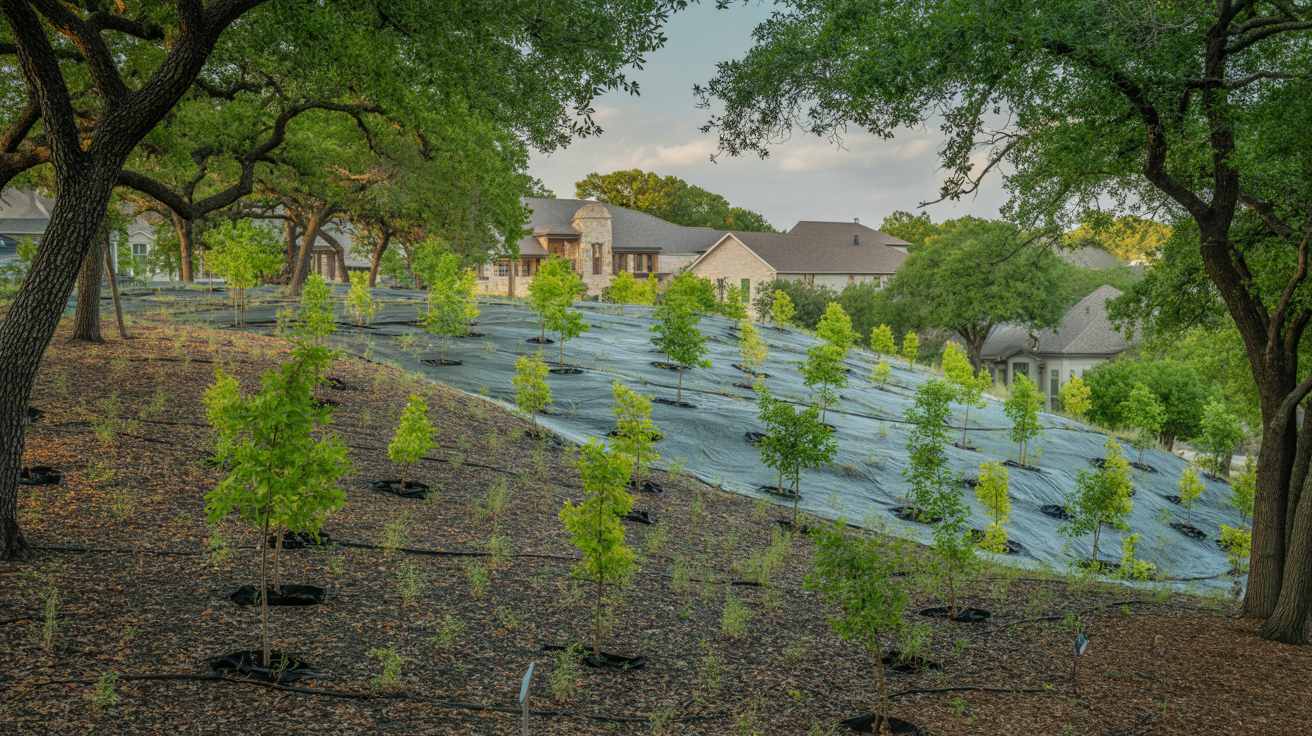
After planting, apply a 2- to 3-inch layer of mulch around the tree, keeping it a few inches away from the trunk. Mulch conserves moisture, moderates soil temperature, and suppresses weeds—but piled against the trunk, it holds moisture that can rot the bark and create entry points for pests and diseases. This "mulch volcano" mistake is extremely common, and I see it in residential and commercial landscapes all over Cedar Park.
Staking is sometimes necessary, especially for larger trees or exposed sites, but it should be minimal and temporary. Use flexible ties that won't cut into the bark, and remove the stakes after one growing season. Trees need to move slightly in the wind to develop strong trunk taper and root systems. Over-staking creates weak, dependent trees that don't develop proper structure.
Maintenance and Long-Term Care Strategies
Planting a tree is just the beginning. What you do—or don't do—in the months and years afterward determines whether that tree thrives or struggles. Proper maintenance is especially important in Central Texas, where drought, alkaline soils, and various pests create ongoing challenges.
Watering and Establishment
Newly planted trees need consistent moisture for the first two growing seasons as they establish their root systems. In Cedar Park's climate, that typically means watering deeply once or twice a week during the growing season, depending on rainfall and temperatures. Deep watering encourages roots to grow downward, making the tree more drought-tolerant once established. Frequent shallow watering does the opposite—it keeps roots near the surface where they're vulnerable to heat and drought stress.
I recommend using a soaker hose or drip irrigation rather than overhead sprinklers. This delivers water directly to the root zone with minimal waste to evaporation. During extreme heat or drought, even established trees may need supplemental watering to maintain health and vigor. The investment in proper irrigation during establishment pays dividends for the life of the tree.
Pruning and Structural Development
Young trees benefit from training pruning to develop strong structure. The goal is to establish a central leader (main trunk) with well-spaced lateral branches that form the permanent scaffold. Remove any branches that form narrow angles with the trunk, cross other branches, or grow downward. This early intervention prevents structural problems that become hazards as the tree matures.
Once trees are established, they should be evaluated for pruning every five to seven years. Mature tree pruning focuses on removing dead or diseased wood, clearing sight lines and infrastructure, and maintaining the tree's natural form. Aggressive pruning or "topping"—cutting back large branches to stubs—is harmful and should never be done. It destroys the tree's structure, creates entry points for decay, and stimulates weak, poorly attached regrowth.
Cedar Park has clearance requirements for trees near streets and sidewalks: branches need to be at least 14 feet above roadways and 8 feet above sidewalks. These standards ensure pedestrian and vehicle safety while maintaining the tree's health and appearance. Professional pruning that follows industry standards is always worth the investment over cheap, aggressive cutting that compromises tree health.
Dealing with Oak Wilt and Other Local Threats
Oak wilt is a serious fungal disease that kills oak trees, and it's active throughout Central Texas. The disease spreads through root grafts between nearby trees and through sap-feeding beetles that are attracted to fresh wounds. To minimize risk, avoid pruning oaks during the spring growing season when beetle activity peaks. If an oak is wounded or needs pruning during high-risk periods, seal the cuts immediately with wound dressing.
If you have an oak that shows symptoms of oak wilt—leaf discoloration, premature leaf drop, fungal mats under the bark—contact a professional immediately. Trenching to sever root connections with nearby oaks and removing the infected tree may be necessary to prevent spread to other trees on your property or in your neighborhood. This is not a DIY situation—oak wilt management requires specialized knowledge and equipment.
Other threats include various pests, drought stress, and root damage from construction or trenching. Regular monitoring and prompt response to problems keeps small issues from becoming major crises. At Earth in Motion, we emphasize preventive care and early intervention because they're always more cost-effective than emergency response after a tree has declined severely.
Understanding Cost Factors for Tree Planting Projects
One of the first questions clients ask is about cost, and it's a fair concern. Tree planting projects can range widely depending on several key factors, and understanding these drivers helps you make informed decisions about your investment.
What Influences Tree Planting Costs
Species selection plays a significant role. Native species sourced from local nurseries are generally more affordable than rare or imported varieties. Larger specimens cost more upfront but provide immediate impact and may be worth the premium for key focal points in your landscape. However, smaller trees often establish faster and may actually outperform larger transplants within a few years.
Site conditions dramatically affect cost. Easy access with good soil conditions keeps labor and material costs reasonable. Difficult sites—steep slopes, poor drainage, rocky soil, or restricted access—require more time, specialized equipment, and soil amendments, all of which add up. I've worked on projects where site challenges doubled the cost compared to a similar project on flat, accessible terrain with decent soil.
The scope of work matters too. A single tree planting is straightforward, but a comprehensive landscape installation with multiple trees, proper irrigation, and extensive site preparation involves much more labor and coordination. Bulk plantings can benefit from economies of scale, but each tree still needs proper handling and planting to ensure success.
Long-Term Maintenance Considerations
Don't forget to factor in ongoing maintenance costs when planning your tree planting project. Watering during establishment, annual mulching, periodic pruning, and pest or disease management are recurring expenses that accumulate over the tree's lifetime. These costs are manageable if you budget for them, but they catch people off guard if they view tree planting as a one-time expense with no follow-up.
Professional services—certified arborist consultations, specialized pruning, disease management—command higher rates than basic maintenance, but they're often essential for keeping valuable trees healthy. Cutting corners on tree care usually costs more in the long run when you have to remove and replace failed trees or deal with hazards from declining specimens.
The most cost-effective approach is to invest appropriately upfront in quality trees, proper planting, and establishment care, then maintain them consistently. This strategy maximizes your return on investment and avoids the boom-and-bust cycle of cheap planting followed by expensive removals and replacements.
How Earth in Motion Approaches Tree Planting Projects
At Earth in Motion, our approach to tree planting is grounded in practical experience and a commitment to long-term results. We're not just putting plants in the ground to check a box—we're creating landscapes that will thrive for decades with proper care. That means starting with a thorough site assessment, understanding your goals and constraints, and developing a planting plan that balances regulatory compliance, aesthetic objectives, and ecological sustainability.
Site Assessment and Planning
Every project starts with understanding the site. We evaluate soil conditions, drainage, sun exposure, existing vegetation, and infrastructure constraints. We identify opportunities and limitations before making any species recommendations. This upfront investment in planning prevents costly mistakes and ensures that the trees we plant are set up for success from day one.
We also consider the long-term picture. What will this landscape look like in 10, 20, or 50 years? Are we creating maintenance problems or solving them? How does this project fit into the broader goals for your property? These questions guide our recommendations and help you make informed decisions about species selection, placement, and care strategies.
Professional Installation and Follow-Through
When it comes to installation, we follow proven techniques that prioritize root health, proper depth, and good soil contact. We source quality specimens from reputable nurseries, handle them carefully, and plant them correctly the first time. We don't cut corners on site preparation or initial care because we know those steps are critical for establishment.
After planting, we provide clear guidance on watering, mulching, and ongoing care. We're available to answer questions and address concerns as your trees establish. If problems arise—drought stress, pest issues, or other challenges—we can diagnose them quickly and recommend appropriate interventions.
Beyond Trees: Comprehensive Land Solutions
While this article focuses on tree planting, it's worth noting that at Earth in Motion, we take a comprehensive approach to land management. Trees don't exist in isolation—they're part of a larger landscape system that includes drainage, erosion control, hardscaping, and other elements. Our background in construction and land development gives us the perspective to integrate tree planting with these other components in ways that enhance both functionality and aesthetics.
Whether you're working on a residential property, a commercial development, or a conservation project, we bring practical solutions informed by two decades of experience across different environments and project types. We understand Central Texas conditions intimately, but we've also worked in other regions and can apply lessons learned from those environments to solve challenging problems here.
Contributing to Cedar Park's Urban Forest Future
Individual tree planting decisions add up to create the urban forest that defines our community's character and environmental health. Cedar Park has the potential to significantly expand its tree canopy if property owners embrace strategic planting and commit to proper care. The city has identified thousands of available planting sites in rights-of-way and on private property within 30 feet of the curb—spaces that could support new trees if people take action.
The Importance of Species Diversity
One of the biggest opportunities for improving Cedar Park's urban forest is diversification. The current dominance of live oak and cedar elm, while understandable given their hardiness, creates vulnerability. By intentionally planting a wider variety of native and adapted species, we can build resilience against pests, diseases, and climate variability. This doesn't mean abandoning live oak—it remains an excellent choice for many situations—but it does mean making room for pecan, Texas ash, cedar elm, desert willow, redbud, and other worthy species that add ecological and aesthetic value.
Diversity also creates a more dynamic and interesting landscape. Different trees bloom at different times, provide different kinds of wildlife habitat, and create varied visual interest throughout the seasons. A monoculture of one or two species is visually monotonous and ecologically simplified compared to a diverse mix that mimics natural ecosystems.
Balancing Aesthetics and Function
Tree planting should serve both aesthetic and functional goals. Shade trees reduce cooling costs and make outdoor spaces more comfortable. Trees strategically placed for screening provide privacy and buffer noise. Street trees create walkable neighborhoods and increase property values. Wildlife habitat trees support pollinators and birds. The best landscapes integrate these functions seamlessly so that trees earn their keep in multiple ways.
This is where professional guidance makes a real difference. It's easy to plant a tree that looks nice initially but causes problems later because it's the wrong species for the site or poorly placed relative to infrastructure. Working with someone who understands both the technical requirements and the long-term outcomes helps you avoid those pitfalls and create landscapes that deliver sustained benefits.
Taking Action: Your Next Steps
If you're ready to move forward with tree planting on your Cedar Park property, here's what I recommend:
Start with a plan. Don't just buy trees on impulse at the garden center and start digging. Understand your site conditions, review the city's approved species list, and think through where trees will provide the most value. Consider working with a professional to assess your property and develop a comprehensive landscape plan that addresses both immediate needs and long-term goals.
Choose appropriate species. Prioritize native and well-adapted trees that can handle Central Texas conditions without excessive inputs. Match species to your specific site—sun exposure, soil type, available space, and proximity to infrastructure. Don't force a tree into a location where it won't thrive just because you like how it looks.
Plant correctly. Follow proper techniques for hole preparation, root handling, depth, and backfilling. Expose the root flare, eliminate circling roots, and ensure good drainage. Apply mulch properly—not piled against the trunk—and establish an irrigation plan for the establishment period.
Commit to maintenance. Budget time and resources for watering, mulching, pruning, and monitoring. Catch problems early when they're manageable. Work with qualified professionals for specialized tasks like oak wilt management or structural pruning.
Think long-term. The tree you plant today will shape your property and neighborhood for decades. Make decisions that consider mature size, maintenance requirements, and ecological contributions. Be patient—trees grow slowly, but the investment pays increasing dividends as they mature.
Final Thoughts on Tree Planting in Cedar Park
I've spent my career working with land—moving earth, managing water, creating structures that solve problems for my clients. Trees are living infrastructure, and they require the same thoughtful approach we bring to any construction project. You need to understand the constraints, plan carefully, execute properly, and follow through with maintenance. When you do that, trees deliver tremendous value that compounds over time.
Cedar Park has strong regulations and good resources to support tree planting, but success ultimately depends on individual property owners making smart decisions and committing to proper care. Whether you're planting one tree or a hundred, the principles are the same: right species, right place, right technique, right maintenance. Get those elements aligned, and you'll be contributing to a more beautiful, sustainable, and resilient community for generations to come.
At Earth in Motion, we're here to help you navigate the complexities of tree planting in Cedar Park and deliver solutions that work in the real world of Central Texas land management.
Frequently Asked Questions About Tree Planting in Cedar Park
What tree species does Cedar Park approve for new plantings, and which ones will actually thrive in Central Texas conditions?
Cedar Park maintains an approved species list that prioritizes native and well-adapted trees proven to handle our alkaline soils, extreme heat, and unpredictable rainfall patterns. The backbone species include live oak, cedar elm, pecan, Texas ash, and various other oak varieties for major shade trees. For ornamental options, Texas redbud, desert willow, Mexican plum, and crape myrtle varieties add seasonal color and fit smaller spaces. At Earth in Motion, I've learned over 20 years that matching species to your specific site conditions—soil type, drainage, sun exposure, and available space—is more critical than just picking from the approved list. We evaluate each property individually to recommend trees that won't just survive but truly thrive in your particular microclimate and soil conditions.
What are Cedar Park's minimum tree planting requirements for new developments and residential properties?
Cedar Park requires at least one tree and three five-gallon shrubs for every 1,000 square feet of required landscaping area, with additional buffer yard requirements depending on your development type and adjacent land uses. If you have existing trees over 8-inch caliper, you may need tree surveys and preservation plans before proceeding with development. The city also enforces specific setback rules—trees must be 15 feet from overhead power lines, 10 feet from fire hydrants, 25 feet from street intersections, and 5 feet from driveways. At Earth in Motion, we start every project by understanding these constraints upfront, because proper planning prevents costly mistakes and ensures your landscape meets all requirements while achieving your aesthetic and functional goals.
How do I determine the right location and spacing for trees on my Cedar Park property?
Proper tree placement requires balancing city setback requirements, utility locations, mature tree size, and your specific landscape goals. Before we plant anything at Earth in Motion, we call 811 to mark underground utilities and map out overhead constraints like power lines. Trees need 20 to 50 feet spacing from each other depending on mature size, and we always consider what's happening above and below ground. I've seen too many situations where someone planted a tree that looked perfect initially, then 10 years later it's grown into power lines or its roots are damaging infrastructure. We evaluate your entire site—soil conditions, drainage, sun exposure, existing vegetation—to identify the locations where trees will provide maximum benefit without creating future maintenance headaches or safety issues.
What factors influence the cost of professional tree planting projects in Cedar Park?
Several key factors drive tree planting costs, starting with species selection and specimen size. Native species from local nurseries are generally more cost-effective than rare varieties, while larger specimens cost more upfront but provide immediate impact. Site conditions dramatically affect project costs—easy access with decent soil keeps expenses reasonable, but challenging terrain, poor drainage, rocky soil, or restricted access require specialized equipment and additional labor. The scope of work matters too, from single tree installations to comprehensive landscape projects with irrigation and extensive site preparation. At Earth in Motion, we also factor in long-term maintenance considerations because proper establishment care, ongoing watering, periodic pruning, and pest management are recurring investments that ensure your trees thrive rather than struggle and require replacement.
What's the proper technique for planting trees to ensure long-term success in Central Texas conditions?
Successful tree planting starts with digging a hole two to three times wider than the root ball but no deeper than the root ball's height, ensuring the root flare sits at or slightly above ground level. I always inspect container trees for circling roots and cut them away before planting, and remove burlap and wire baskets from balled trees after positioning. We backfill with native soil rather than heavy amendments, water thoroughly to eliminate air pockets, and apply 2-3 inches of mulch around the tree while keeping it away from the trunk. At Earth in Motion, we focus on creating good drainage and proper root-to-soil contact because Central Texas clay soils can create bathtub effects that drown trees if not handled correctly. The establishment period requires consistent deep watering for two growing seasons, and we provide clear guidance on irrigation, mulching, and monitoring to ensure your investment pays off for decades.
Hire Us