Tree Planting in Lakeway: Rules, Species & Oak Wilt Guide
Tree Planting in Lakeway: What Every Property Owner Needs to Know Before Breaking Ground
Tree planting in Lakeway isn't just about picking a sapling and digging a hole. If you're a homeowner here, you've probably heard about oak wilt, a fungal disease that's been devastating trees across Central Texas for decades. I'm Chad Burnell, founder of Earth in Motion, Inc., and after more than twenty years working in construction and site development around Austin and the Hill Country, I've seen what happens when people don't understand the local regulations and environmental challenges before they plant. In Lakeway, the city takes tree health seriously because oak wilt has killed so many beautiful oaks that define this area's character. The rules exist to protect your investment, your neighbors' properties, and the entire urban forest we all share.
This article walks you through everything you need to know about planting trees on your Lakeway property. We'll cover the ordinances you must follow, how to choose species that will thrive in our climate, proper planting techniques, and the ongoing care required to keep your trees healthy. Whether you're landscaping a new home site or adding shade to an existing yard, understanding these factors up front will save you time, money, and frustration down the road.
Why Lakeway Has Strict Tree Planting Rules
Lakeway's tree ordinances aren't arbitrary red tape. They exist because of a real, ongoing threat: oak wilt. This fungal disease spreads through interconnected root systems underground and through beetles that are attracted to fresh wounds on oak trees. Once an oak gets infected, it usually dies within weeks to months. Red oaks go faster than live oaks, but both are vulnerable. I've walked properties where entire groves of mature oaks died because one infected tree wasn't handled properly.
The city enacted the Diseased Tree Ordinance to slow the spread of this disease. The rules ban pruning oaks during certain times of year when beetles are most active, require immediate sealing of any cuts or wounds on oak trees, and restrict which oak species you can plant in areas where oak wilt is already present. Violating these rules can result in fines ranging from five hundred to a thousand dollars per day. That's not a slap on the wrist. The city means business because the consequences of inaction affect everyone.
Here's the reality: back in the 1980s when Lakeway was being developed, live oaks were planted everywhere. They're beautiful, iconic Texas trees, and property owners loved them. But planting so many of the same species in close proximity created a perfect environment for oak wilt to spread like wildfire through root grafts. Now we're dealing with the fallout. The ordinance isn't about punishing homeowners. It's about learning from past mistakes and preventing future losses.
What the Diseased Tree Ordinance Covers
The ordinance includes several key requirements that directly impact tree planting and care:
- Seasonal Pruning Ban: You cannot prune oak trees between February 1 and June 30. This is when the beetles that spread oak wilt are most active. Any pruning during this period requires emergency approval from the City Forester, and you'd better have a good reason like a broken limb threatening your house.
- Immediate Wound Sealing: If you do prune an oak at any time of year, you must seal the wound immediately with a tree wound dressing. We're talking within minutes, not hours.
- Dead Tree Removal: If an oak dies, you're required to remove it promptly and dispose of the wood properly. You can't leave it stacked in your yard or use it for firewood if it's infected.
- Planting Restrictions: You cannot plant oak wilt-susceptible species like live oaks or Texas red oaks within active oak wilt centers. The city maintains maps showing where these centers are located.
These rules apply to your private property, not just public land. City staff and forestry agents have the authority to inspect trees on your lot if they suspect disease or code violations. At Earth in Motion, when we're working on a site development or landscaping project in Lakeway, we coordinate with the city to make sure every tree-related activity complies with these ordinances. It's not optional.
Choosing the Right Trees for Your Lakeway Property
Species selection is where most people need guidance. The Hill Country climate is unique. We get hot, dry summers with occasional intense drought. Our soils are often shallow and rocky with high pH. Not every tree that looks good at the nursery will thrive here long-term. And because of oak wilt, you need to be strategic about oaks specifically.
Oak Species: Know What's Allowed and What's Not
If you're set on planting oaks, you need to understand the difference between susceptible and resistant species. Live oak and Texas red oak are highly susceptible to oak wilt. In active oak wilt centers, planting these species is prohibited. Even outside those zones, it's risky. If your neighbor's tree gets infected, yours could be next through shared root systems.
The city encourages planting oak wilt-resistant species instead. These include:
- Monterey Oak: Also called Mexican white oak. It's more resistant to oak wilt and handles our climate well.
- Lacey Oak: A beautiful Hill Country native with blue-green foliage. Deer resistant and drought tolerant once established.
- Bur Oak: Large, majestic tree. Needs more space but very resistant to oak wilt.
- Chinkapin Oak: Another white oak family member with good disease resistance and attractive form.
White oaks as a group are much less susceptible to oak wilt than red oaks. If you want an oak on your property, stick with white oak species. I've planted dozens of Lacey oaks on projects around the Austin area, and they perform beautifully once they're established. They're slower growing than live oaks, but that's a small price to pay for long-term survival.
Non-Oak Alternatives for Diversity
Diversifying your landscape is one of the smartest things you can do. Don't put all your eggs in one basket by planting only oaks. Here are some excellent non-oak trees that thrive in Lakeway's conditions:
- Texas Ash: Great for fall color, which is rare in Central Texas. Moderate water needs once established.
- Cedar Elm: Tough, adaptable, and native. Handles drought and poor soil.
- Mexican Plum: Smaller ornamental tree with white spring blooms. Excellent for tight spaces.
- Texas Redbud: Beautiful pink flowers in early spring before leaves emerge. Understory tree that works well under larger canopy trees.
- Escarpment Black Cherry: Native with glossy leaves and small edible cherries. Birds love it.
When we design landscaping plans for clients, we always recommend a mix of species from different families. This approach minimizes risk. If one species gets hit by disease or pests, you don't lose your entire canopy. It also creates more ecological diversity, which benefits wildlife and makes your property more interesting visually.
Considerations for Lakeway's Climate and Soil
Beyond disease resistance, you need to think about water requirements and soil adaptability. Lakeway sits on the Edwards Plateau with limestone bedrock close to the surface in many areas. Tree roots often can't penetrate deep, so they spread laterally instead. This means trees compete for water and nutrients in a shallow root zone.
Choose trees that are drought tolerant once established. Even if you plan to irrigate, you want species that can survive if you're out of town during a hot, dry August and the sprinkler system fails. Native and adapted species are almost always better bets than trees brought in from wetter climates. A river birch might look nice at the nursery, but it's going to struggle here without constant watering.
Also consider sun and shade. Most of Lakeway has intense sun exposure. Trees planted in full sun need to be heat tolerant. If you're planting on the north side of your house or under existing canopy, you can use understory species that prefer partial shade, like redbuds or Mexican plums.
Deer browsing is another factor. Lakeway has a healthy deer population, and they'll eat young trees down to stubs if you don't protect them. Species like Lacey oak and cedar elm are more deer resistant once mature, but even they need protection when young. We often install temporary fencing around new plantings for the first couple of years until the trees get tall enough that deer lose interest.
Understanding Lakeway's Permitting and Spacing Requirements
You can't just plant a tree wherever you want. If you're planting in the city right-of-way, which includes the area between the street and your property line, you need a landscape permit. The city has to approve the species, placement, and spacing. This ensures that trees don't block sight lines for drivers, interfere with utilities, or create safety hazards.
Spacing Standards Based on Tree Size
The city uses mature tree size to determine minimum spacing. This is critical because people often plant trees too close together, thinking they'll look good immediately. Ten years later, the crowns are competing, roots are tangled, and you have to remove healthy trees because there's not enough space. Here's the basic framework:
- Small Trees (up to thirty feet mature height): Space six to fifteen feet apart. Think ornamental trees like redbuds, Mexican plums, or small desert willows.
- Medium Trees (thirty to seventy feet): Space thirty to forty feet apart. This includes most oaks, elms, and ashes.
- Large Trees (over seventy feet): Space forty to fifty feet apart. Bur oaks and large pecans fall into this category.
There are also setback requirements. Trees must be planted at least eight feet from the edge of unpaved streets and appropriate distances from buildings, sidewalks, and utility lines. If you're too close to structures, roots can damage foundations, driveways, and underground pipes over time. I've seen it happen. A beautiful live oak planted five feet from a house creates a maintenance nightmare fifteen years later when roots lift the foundation.
Right-of-Way and Visibility Restrictions
Trees planted near streets and intersections must not obstruct driver visibility. There are specific sight triangle requirements at corners. If you plant a tree that blocks views, the city can require you to remove it at your expense. Before planting anything near the street, check the city code or consult with the planning department.
If you're installing artificial turf, you cannot place it within the dripline of protected trees. The dripline is the area directly under the outer edge of the tree canopy. Turf prevents water infiltration and oxygen exchange to roots, which stresses trees. The city prohibits this practice to protect tree health.
How to Plant a Tree the Right Way
I've seen plenty of trees planted wrong over the years. The most common mistakes are planting too deep and not preparing the planting hole correctly. These errors kill more trees than disease or drought. Let me walk you through the process we use at Earth in Motion when planting trees on site development projects.
Site Assessment and Preparation
Before you dig, assess the site. Check for underground utilities. Call 811 to get utility lines marked. Hitting a gas line or fiber optic cable is expensive and dangerous. Look at drainage patterns. Trees don't like standing water. If the area floods during heavy rain, choose a different spot or improve drainage first.
Evaluate the soil. Dig a test hole about a foot deep to see what you're working with. If you hit solid limestone six inches down, that's a problem. You may need to create a raised planting area with imported soil or select a species with shallow roots that can handle that condition.
Consider sunlight throughout the day. Trees sold as "full sun" need at least six hours of direct sunlight daily. If your site gets morning sun but is shaded by the house in the afternoon, that's partial sun, and you need to adjust species selection accordingly.
Digging the Hole and Planting Depth
Dig the hole two to three times wider than the root ball but no deeper. This is crucial. The top of the root ball should sit at or slightly above the existing grade. Planting too deep is the number one killer of newly planted trees. The root flare, where the trunk widens at the base, should be visible above the soil line after planting.
Rough up the sides of the hole with a shovel or pick to prevent glazing. In our clay and caliche soils, the sides of the hole can become smooth and hard, which inhibits root penetration. Scarify the sides so roots can grow outward into native soil.
Remove any burlap, wire baskets, or containers from the root ball. If the tree is root-bound with roots circling the container, gently tease them apart and spread them outward. Circling roots continue to circle after planting, eventually girdling and killing the tree.
Backfill with the native soil you removed. Don't amend the backfill with compost or potting mix. This creates a textural boundary that roots won't cross. You want to encourage roots to grow into the surrounding native soil, not stay confined to a pocket of rich planting mix. Tamp the soil gently as you backfill to eliminate air pockets, but don't compact it so hard that water can't infiltrate.
Mulching and Staking
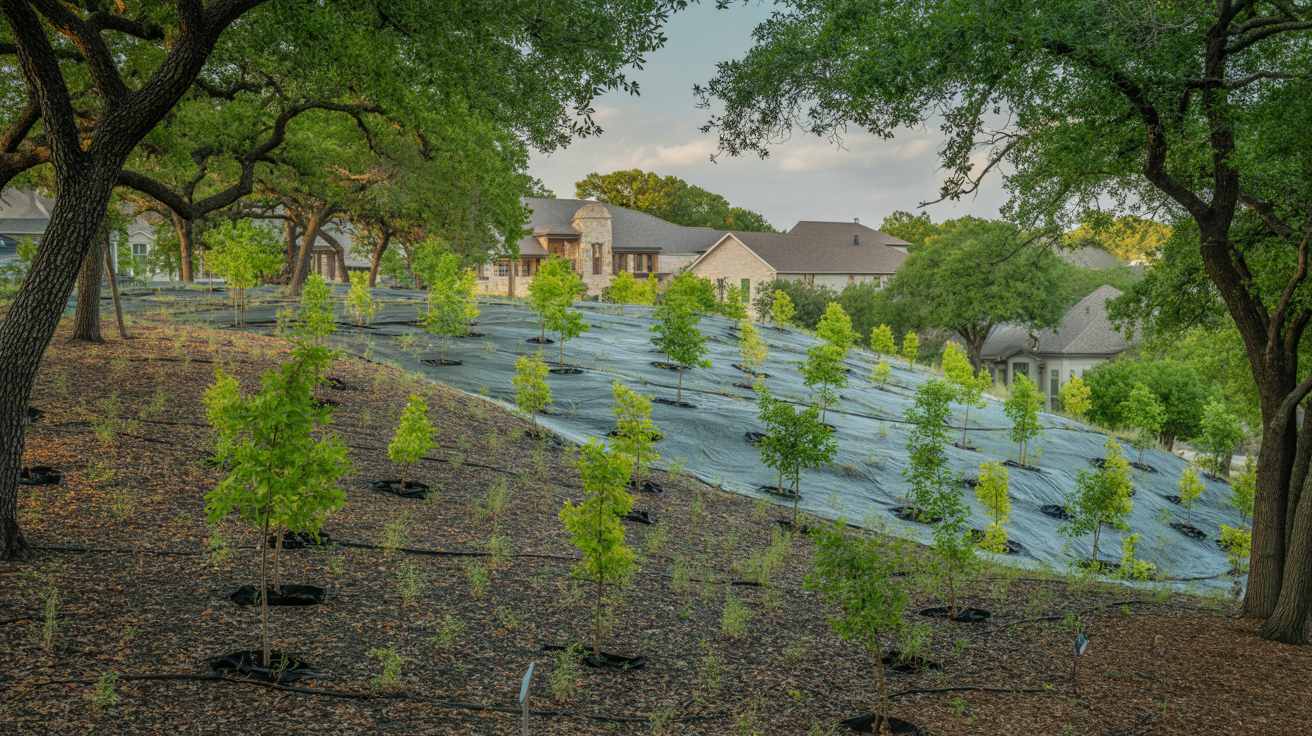
Apply a three to four inch layer of organic mulch around the base of the tree, extending out to the dripline if possible. Keep the mulch pulled back a few inches from the trunk itself. Mulch piled against the trunk holds moisture and encourages rot and disease. The mulch layer conserves soil moisture, moderates soil temperature, and suppresses weeds.
Most trees don't need staking unless they're in a very windy location or the root ball is small relative to the canopy. If you do stake, use flexible ties and remove the stakes after one year. Leaving stakes in place too long prevents the trunk from developing strength and can damage the bark.
Watering and Ongoing Maintenance
Planting the tree correctly is only the beginning. The first two years after planting are critical for establishment. During this period, your tree needs supplemental watering, even if it's a drought-tolerant species. The roots are limited to the original root ball and can't access water from a wider area yet.
Watering Schedule and Techniques
Water deeply and infrequently rather than shallowly and often. Deep watering encourages deep root growth, which makes the tree more drought resistant long-term. Shallow, frequent watering keeps roots near the surface where they're vulnerable to heat and drying.
For the first few weeks after planting, water every two to three days depending on weather. Check soil moisture by sticking your finger into the soil near the root ball. If it's dry two inches down, it's time to water. After the first month, you can reduce frequency to once a week during hot weather, less often during cool or rainy periods.
Use a soaker hose, drip irrigation, or a garden hose set to a slow trickle. Let the water soak in slowly over the course of an hour. Applying water too fast causes runoff and doesn't penetrate the root zone effectively. In Lakeway's rocky soils, infiltration can be slow, so patience is key.
During extended drought, even established trees need supplemental water. You'll see signs of stress like leaf wilting, premature leaf drop, or branch dieback. Don't assume a tree can fend for itself just because it's been in the ground for a few years. I've seen five-year-old trees die during severe drought because the owner stopped watering.
Monitoring for Oak Wilt and Other Diseases
Keep an eye on your trees for signs of disease, especially if you have oaks. Oak wilt symptoms include rapid leaf drop starting at the top of the canopy, leaves turning brown from the edges inward, and wilting during the growing season. If you see these signs, call a certified arborist immediately. Early detection can sometimes save a live oak if fungicide treatment is applied quickly. Red oaks cannot be saved once infected and must be removed to prevent spread.
Other common issues include root rot from overwatering, iron chlorosis from high pH soil, and pest infestations. Most of these problems can be managed if caught early. Regular inspection of your trees, especially during the growing season, helps you spot issues before they become catastrophic.
Pruning and Long-Term Care
For the first few years, limit pruning to removing dead or damaged branches. Don't try to shape the tree aggressively while it's establishing. Once the tree is growing vigorously, you can begin structural pruning to develop a strong central leader and well-spaced branches.
Remember the seasonal pruning ban for oaks. If you need to prune an oak, do it between November and January when beetles are dormant. In summer when temperatures are consistently above one hundred degrees, beetle activity drops, and pruning becomes safer, but this window is narrow and unpredictable. For most homeowners, winter pruning is the safest bet.
Always seal oak wounds immediately after cutting, regardless of the time of year. Use a commercial tree wound dressing or spray paint. The goal is to prevent beetles from landing on the fresh wound and transmitting oak wilt spores.
Property Owner Responsibilities Under Lakeway Ordinances
As a property owner, you're legally responsible for maintaining your trees in a healthy condition. The city code requires that trees present a neat and orderly appearance. If a tree dies, you must replace it within one month on an inch-for-inch basis. This means if you lose a six-inch diameter tree, you need to plant a replacement with equivalent total caliper, either as one six-inch tree or multiple smaller trees that add up to six inches.
You're also responsible for removing dead or diseased trees promptly. Leaving a dead oak standing is a violation because it can harbor oak wilt and spread disease to neighboring properties. The city can issue citations and fines for non-compliance.
If you suspect a tree has oak wilt or another serious disease, don't try to handle it yourself. Contact a certified arborist familiar with local ordinances and oak wilt management. Improper removal or disposal of infected wood can spread the disease further. Professional arborists know how to remove diseased trees safely, dispose of the wood properly, and treat adjacent trees if necessary.
Working Within the Regulatory Framework
Some property owners view these regulations as burdensome. I understand the frustration. You own the land, and you should be able to manage your trees as you see fit, right? The problem is that oak wilt doesn't respect property lines. If your tree gets infected and you don't handle it properly, your neighbors' trees are at risk. The ordinances exist because individual action affects the community.
The best approach is to work within the framework proactively. Verify whether your property is in an active oak wilt center before selecting species. Consult the city's downloadable guides for recommendations on deer resistance, drought tolerance, and sun requirements. If you're planning major landscaping work, consider hiring a professional who understands the local regulations and can ensure compliance from the start. Correcting mistakes after the fact is always more expensive than doing it right the first time.
Why Professional Site Assessment Matters
At Earth in Motion, we approach every project with a focus on understanding the site conditions first. Before we recommend a planting plan or start any excavation, we assess drainage, soil type, sun exposure, existing vegetation, and local ordinances. This isn't wasted time. It's the foundation for successful long-term outcomes.
How Site Conditions Affect Tree Selection
No two properties are exactly alike. I've worked on sites where soil depth varies from two feet to six inches over a distance of fifty feet because of underlying limestone ledges. I've seen properties where the drainage flows one direction in light rain and a completely different direction in heavy rain. These details matter when you're selecting tree species and planting locations.
For example, if your property has a low spot that holds water after storms, you need a tree species that tolerates wet feet occasionally. A bur oak might work, but a cedar elm would be even better. If you plant a species that requires well-drained soil in that spot, it will decline within a few years.
Slope is another factor. Trees planted on steep slopes need deeper root systems to anchor against erosion and wind. Planting on a slope also affects watering. Water runs downhill, so trees at the top of the slope dry out faster than trees at the bottom. You need to adjust irrigation accordingly.
Integrating Trees Into Broader Landscape and Site Development Plans
If you're developing a property or doing extensive site work, tree planting needs to integrate with grading, drainage, hardscaping, and utility installation. Trees planted too close to a future driveway or patio will cause problems later. Trees planted without considering drainage can create erosion issues or standing water problems.
We've completed projects throughout Central Texas where site conditions required creative solutions. On one property near Austin, we worked around extensive limestone outcrops by creating raised planting beds with imported soil and selecting species adapted to shallow root zones. On another project, we integrated tree planting with a custom pond and drainage system to manage stormwater while enhancing the landscape aesthetically. These projects required coordination between excavation, grading, and planting to achieve the client's goals within local regulations.
Common Mistakes to Avoid When Planting Trees in Lakeway
I've seen the same mistakes repeated over and over. Here are the most common ones and how to avoid them:
Planting the Wrong Species in the Wrong Place
This is the biggest error. People fall in love with a tree at the nursery without considering whether it's suited to their site or compliant with local ordinances. A live oak looks great, but if you're in an active oak wilt center, it's prohibited. A weeping willow is beautiful, but it needs constant water and will die in a typical Lakeway landscape.
Take the time to research species before you buy. Use the city's guides. Talk to a professional arborist or landscape designer familiar with the area. Spending an hour on research can save you thousands of dollars and years of frustration.
Planting Too Deep
I mentioned this earlier, but it's worth repeating because it's so common. Trees planted too deep suffocate. The root flare must be visible above the soil line. If you can't see where the trunk flares out at the base, it's buried too deep. Dig down and expose the flare before planting.
Ignoring Spacing Requirements
People plant trees too close together because they want instant shade and privacy. Five years later, the trees are competing for light, water, and nutrients. Fifteen years later, you're removing half of them because they're crowding each other out. Follow the spacing guidelines based on mature size. Be patient. Trees will fill in over time.
Neglecting Watering During Establishment
The assumption that a tree can survive on rainfall alone during the first few years is a recipe for failure, especially during drought. Even native, drought-tolerant species need supplemental water while establishing. Don't plant a tree and walk away. Commit to watering for at least two years.
Pruning Oaks During the High-Risk Period
This is a violation of city ordinance and a significant disease risk. If you absolutely must prune an oak between February and June, you need approval from the City Forester. Otherwise, wait until late fall or winter. The risk of spreading oak wilt is too high to take shortcuts.
Long-Term Benefits of Proper Tree Planting
When you plant trees correctly and maintain them properly, the benefits compound over time. Mature trees increase property value. Studies show that homes with established landscaping sell for more than comparable homes without trees. Trees provide shade, which reduces cooling costs in summer. They improve air quality, reduce stormwater runoff, and create habitat for wildlife.
In a community like Lakeway, trees are part of the identity. The Hill Country landscape with its mix of oaks, cedars, and other native species is what draws people here. By planting responsibly and following the ordinances designed to protect tree health, you're contributing to that legacy. You're ensuring that future generations can enjoy the same natural beauty that exists today.
How Earth in Motion Approaches Tree Planting Projects
When we take on a project that involves tree planting, we start with a conversation about your goals. What do you want the trees to accomplish? Shade? Privacy? Aesthetics? Wildlife habitat? Understanding your priorities helps us recommend species and placement that align with your vision.
Next, we assess the site. We look at soil, drainage, sun exposure, and existing vegetation. We identify any constraints like utility easements, setback requirements, or active oak wilt centers. We check local ordinances to ensure compliance with spacing, species restrictions, and permitting requirements.
Then we develop a planting plan. This plan includes species selection, planting locations, spacing, and a timeline for installation. We explain why we're recommending certain species and how they fit your site conditions and goals. We walk you through the maintenance requirements so you know what to expect after planting.
During installation, we follow best practices for site preparation, planting depth, backfilling, and mulching. We use quality nursery stock and handle root balls carefully to minimize transplant shock. If staking is needed, we install it correctly and advise you when to remove it.
After planting, we provide guidance on watering schedules, monitoring for stress or disease, and long-term care. We're available to answer questions as your trees establish. Our goal is to set you up for success, not just complete a job and move on.
Looking Ahead: Building a Sustainable Urban Forest in Lakeway
The challenges facing Lakeway's urban forest aren't going away. Oak wilt will continue to be a threat for the foreseeable future. Drought and climate variability will test the resilience of our trees. Development pressure will continue to impact natural areas.
But there's reason for optimism. The city's ordinances, while strict, are effective when followed. Property owners who take tree health seriously can create landscapes that thrive despite these challenges. By diversifying species, choosing adapted plants, and committing to proper care, we can build an urban forest that's healthier and more resilient than what was planted decades ago.
This isn't just about following rules. It's about stewardship. The trees you plant today will be here long after you're gone. They'll provide shade and beauty for your children and grandchildren. They'll support wildlife and contribute to the ecological health of the Hill Country.
After more than twenty years in this business, I've learned that the projects that succeed are the ones where the client, the contractor, and the environment are all on the same page. When you understand the local conditions, respect the regulations, and commit to doing the work properly, the results speak for themselves. Whether we're building a custom pond, grading a site for development, or planting trees, the principle is the same: quality, integrity, and attention to detail from start to finish.
If you're ready to move forward with tree planting in Lakeway, take the time to do it right. Educate yourself on species selection and local ordinances. Assess your site honestly. Plan for long-term care, not just initial installation. And if you need help navigating the complexities, reach out to professionals who understand the challenges and solutions specific to Central Texas. Your investment in proper tree planting in Lakeway will pay dividends for decades to come.
Tree Planting in Lakeway: 5 Most Asked Questions
What tree species can I legally plant on my Lakeway property?
The species you can plant depends on whether your property is located in an active oak wilt center. Lakeway prohibits planting highly susceptible oak species like live oak and Texas red oak in these areas. Even outside oak wilt centers, I recommend choosing resistant white oak varieties like Lacey oak, Monterrey oak, or bur oak instead of susceptible red oak species. For diversity, consider native alternatives like Texas ash, cedar elm, Mexican plum, or Texas redbud. At Earth in Motion, we assess your specific site conditions and check current oak wilt maps to recommend species that will thrive long-term while complying with city ordinances. The key is selecting trees adapted to our limestone soils, intense sun, and periodic drought conditions.
Do I need permits to plant trees in Lakeway, and what are the spacing requirements?
You need a landscape permit if you're planting in the city right-of-way between your property line and the street. For private property, permits typically aren't required, but you must follow spacing guidelines based on mature tree size. Small trees under thirty feet need six to fifteen feet spacing, medium trees require thirty to forty feet, and large trees over seventy feet need forty to fifty feet apart. You also need proper setbacks from buildings, streets, and utility lines. When we develop planting plans at Earth in Motion, we ensure compliance with these requirements and help you obtain necessary permits. Proper spacing prevents future problems with competing root systems and crowded canopies.
When is it safe to prune oak trees, and what are the consequences of violating the pruning ban?
Lakeway prohibits pruning oak trees from February 1 through June 30 when beetles that spread oak wilt are most active. Violating this ordinance can result in fines of five hundred to one thousand dollars per day. The safest pruning window is November through January when beetles are dormant. Any oak wounds must be sealed immediately with tree wound dressing to prevent beetle attraction. Emergency pruning during the banned period requires approval from the City Forester. At Earth in Motion, we schedule all oak maintenance work during safe periods and ensure proper wound sealing. Understanding these timing restrictions is critical because oak wilt can kill trees within weeks once infected.
What are my responsibilities as a property owner for tree maintenance and replacement?
Lakeway holds property owners responsible for maintaining trees in healthy condition and replacing dead trees within one month on an inch-for-inch basis. If you lose a six-inch diameter tree, you must plant replacement trees totaling six inches in combined caliper. You're required to remove diseased or dead trees promptly, especially oaks that could harbor oak wilt. Property owners must also ensure trees don't obstruct visibility at intersections or violate setback requirements. When we work with clients at Earth in Motion, we explain these ongoing responsibilities upfront and provide guidance on proper tree care, disease monitoring, and replacement planning to ensure continued compliance with city ordinances.
How should I plant and water newly planted trees to ensure successful establishment?
Proper planting depth is critical - the root flare must be visible at or slightly above ground level. Dig holes two to three times wider than the root ball but never deeper. Backfill with native soil, not amended soil, to encourage root growth into surrounding ground. Apply three to four inches of mulch, keeping it away from the trunk. Water deeply every two to three days for the first month, then weekly during hot weather. Even drought-tolerant natives need supplemental water for two years while establishing. At Earth in Motion, we handle the technical aspects of site preparation, proper planting techniques, and initial establishment care. The investment in correct installation and early maintenance prevents costly tree loss and ensures long-term success in Lakeway's challenging conditions.
Hire Us