Tree Planting Guide for Liberty Hill Property Owners
Tree planting in Liberty Hill is more than just digging a hole and dropping in a sapling—it's about understanding your soil, your climate, and the regulations that shape what you can and should plant on your property. After more than two decades in construction and land development across Central Texas, I've seen property owners make costly mistakes by rushing into tree projects without a clear plan. At Earth in Motion, we approach every tree planting project the same way we approach custom ponds or site work: with careful planning, respect for the land, and a commitment to solutions that last.
Liberty Hill sits in a unique part of Williamson County where the rocky limestone soil, unpredictable rainfall, and intense summer heat create challenges for any vegetation. Add in city development standards and landscaping requirements, and you've got a situation where good intentions can quickly turn into frustration if you don't know what you're doing. I've worked on projects where homeowners thought they were doing everything right, only to watch their newly planted trees struggle or fail within the first year. That's why I'm writing this—to give you the real-world knowledge you need to make smart decisions about tree planting on your property.
Why Tree Selection Matters More Than You Think in Central Texas
The first mistake I see property owners make is falling in love with a tree species that simply won't survive in our climate. You might drive through another part of the country and see beautiful maples or birches, but those trees need conditions we just don't have here. When you're planning your tree planting project, you need to think like the land thinks. Central Texas soil is often shallow, rocky, and alkaline. Our summers are brutal, with weeks of temperatures over 100 degrees and limited rainfall. Winter can surprise you with hard freezes. Your tree selection needs to account for all of this.
Native species have spent thousands of years adapting to these exact conditions. That's why trees like Cedar Elm, Live Oak, and Texas Redbud consistently outperform exotic imports. I've installed dozens of Live Oaks on properties around Austin and Liberty Hill, and they're still thriving decades later because they're built for this environment. When you choose native trees, you're working with nature instead of fighting it. Your trees establish faster, require less water once mature, and resist local pests and diseases better than non-native alternatives.
Understanding Heritage Trees and Regulatory Requirements
Liberty Hill has specific standards about tree preservation and replacement, especially for what they call heritage trees. These are mature specimens of certain species that reach particular diameter measurements—like a Cedar Elm at 25 inches or a Live Oak at 24 inches. If you're purchasing property or planning development work, understanding these designations matters because removing a heritage tree triggers significant replacement obligations. You might need to plant three new trees to offset the removal of one mature heritage specimen.
I've worked on commercial projects where the tree replacement requirements became a major cost factor that the developer hadn't anticipated. The city's point-based landscaping system assigns 50 points to large trees and 25 points to smaller trees, with various site development projects needing to hit specific point thresholds. This isn't arbitrary bureaucracy—it's Liberty Hill's way of maintaining tree canopy coverage as the community grows. When we plan a project at Earth in Motion, we factor these requirements into the initial site assessment so there are no surprises down the road.
The Real Cost Drivers in Professional Tree Planting
People often ask me why professional tree installation costs what it does, and the answer comes down to what happens before and after the tree goes into the ground. The actual planting takes a few hours. The site assessment, soil preparation, proper staking, initial watering protocol, and monitoring through the establishment period—that's where the real work happens. When you hire Earth in Motion for tree planting, you're paying for two decades of experience knowing which trees will thrive in your specific soil conditions and microclimate.
Tree size drives cost significantly because larger specimens require more careful handling, bigger equipment, and more intensive site preparation. A 95-gallon container tree needs a much larger planting hole than a 15-gallon tree, and the soil amendments, staking system, and watering requirements all scale up accordingly. But there's a trade-off: that larger tree gives you immediate impact and shade, potentially adding years to your enjoyment compared to starting with a smaller specimen. I always walk clients through these options so they understand what they're getting for their investment.
Site Conditions That Affect Your Tree Planting Investment
Liberty Hill's limestone-heavy soil presents unique challenges that directly impact installation costs. On some properties, we hit solid rock within 18 inches of the surface. When that happens, you have two choices: bring in equipment to break through the limestone and create proper root space, or select tree species with shallower root systems that can work with limited soil depth. Both approaches work, but they require different levels of site preparation and affect your tree selection differently.
Drainage is another factor that many property owners overlook until it's too late. Central Texas gets intense rainfall events that can dump several inches in a few hours. If your planting site doesn't drain properly, even drought-tolerant trees can develop root rot during wet periods. I've seen beautiful specimens fail not because of drought, but because water pooled around their roots during heavy rains. When we assess your property, we're looking at slope, soil composition, and drainage patterns to ensure your trees go into locations where they'll succeed long-term.
Species Selection for Liberty Hill Success
After working throughout Central Texas for years, I've developed strong opinions about which trees deliver reliable performance for property owners. Let me share the species I recommend most often and why they work in our specific conditions. These aren't trendy choices—they're proven performers that I've watched thrive through droughts, freezes, and everything our climate throws at them.
Shade and Canopy Trees That Deliver
Live Oak: This is the workhorse of Central Texas landscapes. Live Oaks develop massive canopies that provide genuine cooling shade, and their root systems are aggressive enough to find water and nutrients in difficult soil. They're relatively slow-growing, which actually works in your favor because the wood is incredibly strong and resistant to storm damage. I've installed Live Oaks on properties from Austin to Georgetown, and they consistently outperform expectations.
Cedar Elm: If you want a tree that can handle urban conditions, compacted soil, and our temperature extremes, Cedar Elm is your answer. It's a native species with excellent disease resistance and a growth rate that gives you shade within a few years rather than decades. The fall color is a nice bonus—not as dramatic as what you'd see in New England, but attractive yellows that signal the seasonal change.
Bur Oak: For properties with deeper soil, Bur Oak develops into a magnificent shade tree with a distinctive appearance. The acorns are larger than other oak species, and the corky bark adds visual interest. These trees need more water during establishment than Live Oaks, but once mature, they're remarkably tough. I've used Bur Oaks on rural properties where homeowners wanted substantial shade trees that would become legacy features of their land.
Texas Ash: This is one of my go-to recommendations for homeowners who want reliable fall color. Texas Ash adapts well to limestone soils and provides quality shade. The tree is deciduous, which means you lose the canopy in winter, but you gain brilliant orange and red foliage in autumn that rivals anything you'd see in other regions. It's also faster-growing than oaks, giving you results sooner.
Ornamental Trees for Visual Impact
Texas Redbud: In early spring, before most other trees have leafed out, Redbud explodes with purple-pink flowers that completely cover the branches. It's a spectacular sight that signals the end of winter. These are understory trees, meaning they naturally grow beneath larger canopy trees in the wild, so they work well in partially shaded locations where bigger trees might struggle. I use Redbuds extensively in landscape plans because they provide seasonal interest without requiring the space of a major shade tree.
Desert Willow: Despite the name, this isn't actually a willow—it's a drought-tolerant native that produces beautiful trumpet-shaped flowers throughout summer. If you're dealing with dry, difficult sites where water conservation matters, Desert Willow delivers ornamental value without demanding irrigation. The tree has an airy, informal appearance that works particularly well in naturalistic landscapes.
Mexican Plum: This small tree offers fragrant white flowers in early spring followed by edible fruit that wildlife loves. It's another understory species that works well in smaller yards or as part of a layered landscape design. Mexican Plum tolerates our alkaline soils better than many fruiting trees and requires minimal maintenance once established.
Professional Installation Versus DIY Tree Planting
I'm honest with property owners about when professional installation makes sense and when you can handle tree planting yourself. For small ornamental trees in straightforward soil conditions, a motivated homeowner with basic tools can achieve good results by following proper technique. Where professional installation becomes valuable is when you're dealing with large specimen trees, difficult site conditions, or projects that need to meet specific regulatory standards.
At Earth in Motion, our tree installation process starts with site assessment. We examine soil conditions, drainage patterns, sun exposure, and proximity to utilities or structures. This evaluation determines the appropriate planting location and any site preparation needed before the tree arrives. We don't just show up with a tree and a shovel—we bring the equipment and knowledge to prepare the site properly.
The Installation Process That Ensures Success
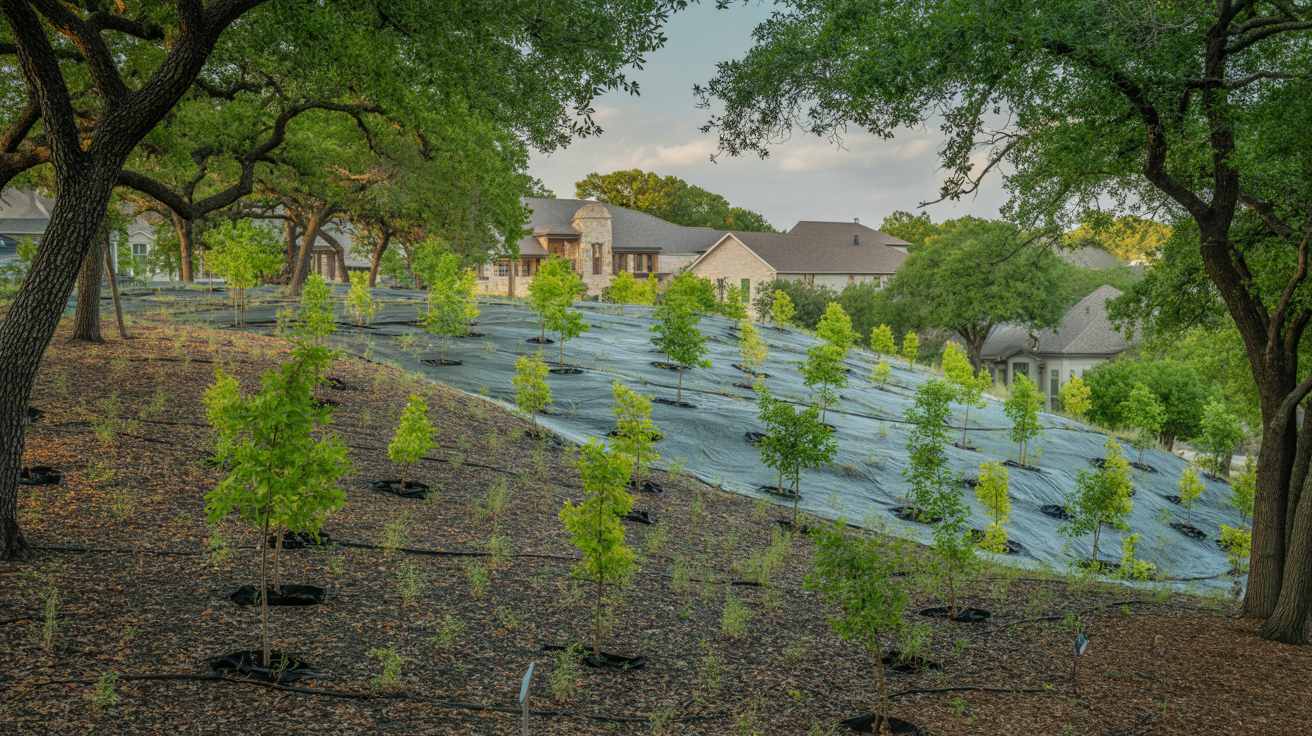
Proper tree planting begins with a hole that's the right size and shape. Too deep, and you risk burying the root flare, which can lead to rot and instability. Too shallow, and roots struggle to establish. The hole should be two to three times wider than the root ball but no deeper than the root ball's height. In Liberty Hill's rocky soil, this often means breaking through limestone and backfilling with amended soil that gives roots a fighting chance during establishment.
We use a soil mix that balances drainage with water retention—crucial in Central Texas where you might go weeks without rain followed by torrential downpours. The mix includes native soil to encourage roots to transition into the surrounding ground, but with amendments that improve the initial growing environment. After positioning the tree at the correct depth and backfilling, we create a watering basin around the perimeter that directs irrigation to the root zone where it's needed.
Staking is necessary for larger trees to prevent wind damage while roots establish, but improper staking causes more problems than it solves. Stakes should allow some trunk movement, which actually strengthens the tree, while preventing the rootball from shifting. We use flexible ties that won't girdle the trunk and position stakes outside the root zone to avoid damage. The staking system typically stays in place for one growing season, then we remove it to allow the tree full independence.
The Critical First Year of Tree Establishment
Most tree failures happen within the first 12 months after planting, and the primary culprit is improper watering. Central Texas property owners face a tricky balance—our clay soils can become waterlogged during wet periods, but during summer drought, trees need consistent moisture to establish roots. I've seen homeowners kill trees with kindness by overwatering, and I've seen trees die from neglect when owners assumed that rain was sufficient.
The watering protocol depends on tree size, time of year, and weather conditions, but here's the general framework we follow at Earth in Motion: For the first month after planting, trees need water every two to three days in warm weather, applying enough to thoroughly soak the root zone. As roots begin extending into surrounding soil, you gradually reduce frequency while increasing the amount per watering. By the end of the first growing season, established trees might only need deep watering every 7-10 days during dry periods.
Monitoring for Problems During Establishment
During the establishment period, you're watching for signs of stress that indicate the tree needs adjustment. Wilting leaves, premature leaf drop, or foliage that turns yellow or brown suggests watering issues—either too much or too little. Inspect the soil at root depth to determine which problem you're facing. If soil is soggy, reduce watering frequency. If it's dry several inches down, water more thoroughly.
Central Texas also brings wildlife challenges that can damage young trees. Deer will browse on tender growth, sometimes severely enough to kill small trees. Rabbits chew bark, particularly during winter when other food sources are scarce. On projects where wildlife damage is likely, we install protective barriers around the trunk and lower branches until trees reach a size where browsing won't threaten their survival. This is particularly important in Liberty Hill's more rural areas where deer populations are significant.
Navigating Liberty Hill's Development and Landscaping Standards
If you're developing property or making significant site modifications in Liberty Hill, you'll encounter the city's Site Development and Design Standards that govern tree planting and preservation. These requirements exist to maintain tree canopy coverage as the community grows, and they affect everything from parking lot design to residential landscaping. Understanding these standards early in your planning process prevents costly surprises during permitting and construction.
The parking area requirement is straightforward: one large tree per ten parking spaces. For commercial projects, this means coordinating tree locations with utilities, drainage, and traffic flow—all before concrete gets poured. I've managed projects where the tree placement requirements significantly influenced the overall site layout, and addressing this during the design phase saved substantial time and cost compared to retrofitting trees into an already-completed parking area.
Using Tree Planting to Offset Mitigation Requirements
Here's where strategic planning pays off: when existing trees must be removed for development, the city requires replacement plantings based on the size of removed trees. For trees between 8 and 19.9 inches in diameter, you replace with one tree. For trees 20 to 25.9 inches, you need two replacement trees. Heritage trees 26 inches or larger require three replacement trees. However, if you're planting new trees that meet city standards, these can offset mitigation fees that would otherwise apply to tree removal.
The landscape points system further complicates (or simplifies, depending on your perspective) the calculation. Large trees contribute 50 points, small trees contribute 25 points, and various other landscape features add additional points. Site development projects need to achieve specific point totals based on property size and use. By strategically selecting and placing trees, you can meet multiple requirements simultaneously—replacement obligations, parking area trees, and points compliance—while creating an attractive, functional landscape.
At Earth in Motion, we handle this analysis as part of project planning. We identify which existing trees qualify for preservation credit, calculate replacement obligations if removal is necessary, and develop a planting plan that satisfies regulatory requirements while meeting your practical and aesthetic goals. This integrated approach ensures compliance without unnecessary cost or complexity.
Long-Term Tree Care and Property Value
Once your trees survive the critical first year, ongoing care becomes simpler but remains important for long-term success. Established trees in Liberty Hill benefit from deep watering during extended droughts, periodic mulching to moderate soil temperature and retain moisture, and occasional pruning to maintain structure and remove damaged or diseased branches. The specific maintenance requirements vary by species—oaks need different care than ornamental trees—but the principles remain consistent.
Mulching is one of the highest-value maintenance activities you can do. A 3-4 inch layer of organic mulch around the tree's drip line (but not touching the trunk) insulates roots from temperature extremes, reduces water evaporation, suppresses weeds, and gradually breaks down to improve soil quality. I recommend refreshing mulch annually, particularly after summer heat has decomposed the previous application. Use natural wood chips or shredded bark rather than dyed mulches that may contain chemicals harmful to soil organisms.
Recognizing When Professional Diagnosis Is Needed
Even with excellent care, trees can develop problems that require expert attention. Oak wilt is a serious disease in Central Texas that kills trees rapidly once symptoms appear. If you notice leaves wilting and discoloring on just one or two branches, particularly during the growing season, that's a warning sign. Similarly, unusual fungal growth on the trunk, large areas of peeling bark, or sudden leaf drop outside of normal seasonal patterns all warrant professional diagnosis.
The challenge is that by the time symptoms are obvious, disease or pest damage may be advanced. That's why periodic inspections by someone who knows what to look for can catch problems early when intervention is still possible. At Earth in Motion, when we install trees as part of larger site development projects, we often establish maintenance schedules that include periodic inspection so problems get identified before they become crises.
Integrating Trees into Comprehensive Site Development
Trees don't exist in isolation on your property—they interact with buildings, utilities, drainage systems, and other landscape features. When I approach a tree planting project, I'm thinking about these relationships and how they'll evolve over years and decades. A Live Oak planted 15 feet from your house might seem appropriately spaced now, but in 30 years when it's 60 feet tall with a massive canopy, that proximity could cause problems with foundations, roofing, or utility lines.
Utility conflicts are among the most common issues I see in poorly planned tree installations. Underground water lines, sewer laterals, electrical service, and irrigation systems all occupy the subsurface where tree roots will eventually grow. Large trees planted directly over utility corridors create inevitable conflicts—either the roots damage the utilities, or you're forced to prune roots aggressively, potentially destabilizing the tree. We map utility locations during site assessment and plan tree placement to minimize future conflicts.
Coordinating Trees with Drainage and Erosion Control
Central Texas properties often struggle with erosion, particularly on sloped sites during heavy rains. Trees can be powerful erosion control tools when positioned strategically. Root systems stabilize soil, canopy intercepts rainfall before it hits the ground with full force, and leaf litter creates organic matter that improves soil structure. But trees also modify drainage patterns, potentially creating wet zones downslope or channeling water in unintended directions.
At Earth in Motion, we often coordinate tree planting with broader drainage solutions. A properly designed swale planted with trees suited to periodic inundation can handle stormwater while providing attractive landscaping. Upland areas might get drought-tolerant species that won't suffer during dry periods. The key is matching species to site conditions rather than trying to modify the site to suit your preferred trees—work with the land, not against it.
Making Smart Decisions About Your Tree Planting Project
After two decades managing projects throughout Central Texas, I've learned that successful tree planting comes down to realistic expectations, proper planning, and execution that respects both regulatory requirements and site conditions. The property owners who get the best results are those who invest time in understanding their options before committing to a particular approach. They ask questions, consider long-term implications, and recognize that quality installation is an investment in property value and daily quality of life.
If you're planning tree planting in Liberty Hill, start by assessing your property honestly. Walk the site at different times of day to understand sun exposure and shade patterns. Dig test holes to see what you're dealing with in terms of soil depth and composition. Identify existing trees and understand whether they qualify for preservation credit or will require replacement if removed. This reconnaissance work, even before you contact a professional, helps you make informed decisions about project scope and approach.
Then consider your goals. Are you planting for shade, privacy, wildlife habitat, regulatory compliance, or some combination? Different objectives suggest different species and placement strategies. A privacy screen requires different trees than a shade canopy, and regulatory compliance might dictate specific quantities or sizes regardless of your aesthetic preferences. Getting clear on priorities helps ensure that the trees you plant actually solve the problems you need addressed.
Why Professional Consultation Pays Off
Even if you ultimately handle the physical tree planting yourself, professional consultation during the planning phase can save you years of problems. At Earth in Motion, we routinely provide site assessments and planting recommendations for property owners who want expert guidance but plan to do the installation work themselves. This modest investment in professional knowledge prevents mistakes that would be expensive or impossible to correct once trees are established.
For larger projects, complex sites, or situations requiring regulatory compliance, professional installation becomes the practical choice. We bring equipment, experience, and established relationships with quality tree suppliers throughout Central Texas. We handle permits and documentation if required, coordinate with other site work like excavation or utilities, and provide warranties that give you confidence in the investment. Our goal is solving problems for property owners, and sometimes the best solution involves removing the complexity and risk of tree installation from your plate entirely.
Whether you're planning a single specimen tree to anchor your front yard or a comprehensive landscaping project that includes dozens of trees to meet development standards, the principles remain the same: understand your site, select species that fit your conditions, install them properly, and provide care during the critical establishment period. Follow this approach, and tree planting in Liberty Hill becomes a rewarding investment that enhances your property and contributes to the community's character for decades to come.
Frequently Asked Questions About Tree Planting in Liberty Hill
What species of trees should I plant on my Liberty Hill property?
At Earth in Motion, I recommend native Central Texas species that thrive in our limestone soil and extreme weather conditions. Live Oak is my top choice for shade trees—I've installed dozens around Austin and Liberty Hill that are still thriving decades later because they're built for our environment. For faster shade, Cedar Elm handles urban conditions and compacted soil exceptionally well. If you want ornamental value, Texas Redbud provides spectacular spring flowers, while Desert Willow offers summer blooms with minimal water requirements. The key is working with your specific site conditions rather than fighting them. During our site assessment, I evaluate your soil depth, drainage patterns, and sun exposure to match the right species to your property's unique characteristics.
Do I need permits or approval for tree planting in Liberty Hill?
Liberty Hill has specific site development standards that affect tree planting, particularly for commercial projects or significant residential landscaping. The city requires one large tree per ten parking spaces for commercial developments and uses a points-based system where large trees contribute 50 points and smaller trees contribute 25 points toward landscaping requirements. If you're removing existing trees, especially heritage trees like Cedar Elms over 25 inches or Live Oaks over 24 inches, you'll face replacement obligations—potentially three new trees for each large heritage tree removed. At Earth in Motion, I handle this regulatory analysis during project planning, identifying which existing trees qualify for preservation credit and developing planting plans that meet compliance requirements while achieving your landscape goals.
What factors determine the cost of professional tree installation?
Tree installation costs depend on several key factors that I evaluate during site assessment. Tree size is the biggest driver—a 95-gallon container tree requires larger equipment, more extensive site preparation, and more intensive staking systems than smaller specimens. Site conditions significantly impact cost: Liberty Hill's limestone-heavy soil often requires breaking through rock to create proper root space, and poor drainage areas need soil amendments to prevent root rot. The installation process includes site preparation, proper soil mixing, staking systems, and establishment monitoring—not just dropping a tree in the ground. Distance from access points, coordination with other site work, and specific regulatory requirements all influence the final investment. At Earth in Motion, I walk clients through these factors so you understand exactly what you're getting for your investment.
Should I hire professionals or plant trees myself?
For small ornamental trees in straightforward conditions, motivated homeowners can achieve good results with proper technique. However, professional installation becomes valuable for large specimen trees, difficult site conditions, or projects requiring regulatory compliance. At Earth in Motion, I bring two decades of experience knowing which trees will thrive in your specific soil and microclimate conditions. Our process starts with comprehensive site assessment—examining drainage, utilities, sun exposure, and soil composition—followed by proper hole preparation, soil amendment, and establishment protocols. We handle the equipment needed to break through limestone, coordinate with utility locations, and provide staking systems that support without damaging your trees. Most importantly, we offer warranties and ongoing monitoring during the critical first-year establishment period when most tree failures occur.
How do I ensure my newly planted trees survive their first year?
The first 12 months after planting are critical, and improper watering kills more trees than any other factor. Central Texas presents unique challenges—clay soils can become waterlogged during heavy rains, but summer drought requires consistent moisture for root establishment. I've seen homeowners kill trees with kindness through overwatering and lose trees to neglect by assuming rainfall is sufficient. The protocol I follow at Earth in Motion involves frequent watering initially—every two to three days for the first month—then gradually reducing frequency while increasing volume per watering as roots extend. By year's end, established trees might only need deep watering every 7-10 days during dry periods. I also address wildlife protection, installing barriers against deer browsing and rabbit damage, and monitor for stress signals like wilting, premature leaf drop, or discoloration that indicate watering adjustments are needed.
Hire Us