Tree Planting Guide for Marble Falls Properties
Tree planting in Marble Falls requires more than just digging a hole and dropping in a sapling—it demands an understanding of our unique Central Texas environment, local regulations, and the long-term commitment needed to help your trees thrive. I'm Chad Burnell, founder of Earth in Motion, and over my 20 years in construction and land management, I've learned that successful tree planting starts with respecting the land you're working with and understanding what it can support.
When I first started working in this region, I made the mistake many newcomers make: I assumed trees would grow the same way they did in other places I'd worked. But Central Texas has its own personality—limestone bedrock, caliche layers, unpredictable rainfall, and soil that can shift from clay to rocky decomposed granite within a few feet. Your property in Marble Falls is no exception. If you want trees that will still be standing strong decades from now, you need to start with the right species, plant them correctly, and give them the care they need during those critical first years.
Understanding Marble Falls' Approved Tree Species
Marble Falls maintains a specific list of trees that work well in our local conditions, and there's a good reason for this. The city has seen which species succeed and which ones struggle or create problems down the line. When you're planning your landscape, you'll want to focus on native trees first—species that evolved here and are naturally adapted to our climate, soil, and water availability.
Think about trees like Live Oak, Cedar Elm, and Bald Cypress. I've planted hundreds of these over the years, and they consistently outperform introduced species when it comes to drought tolerance and survival rates. Live Oaks, for instance, develop deep root systems that tap into moisture even during our brutal summer droughts. Cedar Elms are incredibly tough—they handle our alkaline soils without complaint and provide excellent shade once established.
But native doesn't mean you're limited in your choices. Marble Falls also recognizes well-adapted species that have proven themselves over time in Central Texas. Texas Red Oak, Mexican Redbud, and Texas Mountain Laurel all fit this category. These trees might not be native to this exact location, but they've shown they can handle our conditions and don't pose risks of becoming invasive.
Here's something I always tell clients: bigger isn't always better when you're selecting trees. Consider your property's size and what you're trying to accomplish. If you're working with a smaller lot or planting near structures, small to medium trees like Mexican Redbud or Texas Mountain Laurel make more sense than planting a massive Live Oak that will eventually crowd your house and foundation. I've been called out to too many properties where someone planted the wrong tree in the wrong spot twenty years ago, and now they're dealing with foundation issues, cracked driveways, or branches threatening their roof.
Navigating Local Regulations and Compliance Requirements
Before you plant a single tree in Marble Falls, you need to understand the local ordinances that govern landscaping. The city takes these regulations seriously, and for good reason—they're designed to protect infrastructure, ensure public safety, and maintain the character of our community.
If you're planting trees in areas that fall under city jurisdiction or in regulated zones, you'll need to work from the approved species list. This isn't just a suggestion—it's a requirement. I've worked on projects where clients wanted to use specific trees that weren't on the list, and we had to bring in a registered Texas Landscape Architect to seal the plans before we could proceed. That adds time and cost to your project, so it's worth checking the list first and choosing from species that are already approved.
One of the most critical steps before planting—and this applies everywhere, not just Marble Falls—is calling 811 to locate underground utilities. I cannot stress this enough. In my years of construction work, I've seen the damage that comes from hitting underground lines, and it's never pretty. Electric lines, gas pipes, water mains, fiber optic cables—they're all buried beneath your property, and you need to know exactly where they are before you start digging.
Power lines present another challenge, especially overhead ones. Never plant tall-growing trees directly under power lines. I've seen property owners make this mistake, thinking a small sapling won't be a problem, but fifteen years later they've got a mature tree growing into the lines, creating a fire hazard and eventually requiring expensive removal. If you have overhead lines, stick with smaller trees or plant well away from the lines' footprint.
Distance matters when you're planting near structures, too. Your trees need room to grow without threatening your home's foundation, your driveway, or your neighbor's property. I typically recommend keeping large shade trees at least fifteen to twenty feet from structures, though the exact distance depends on the species and its expected mature size. This is where working with someone who understands both tree biology and construction becomes valuable—you need to think decades ahead, not just about how things look today.
Proper Site Preparation and Planting Techniques
Site preparation is where most tree planting projects succeed or fail, and it's an area where my construction background really comes into play. Before we plant anything at Earth in Motion, I walk the entire site and assess what we're working with. I'm looking at soil type, drainage patterns, sun exposure, wind patterns, and existing vegetation. All of these factors will influence where your trees should go and what care they'll need.
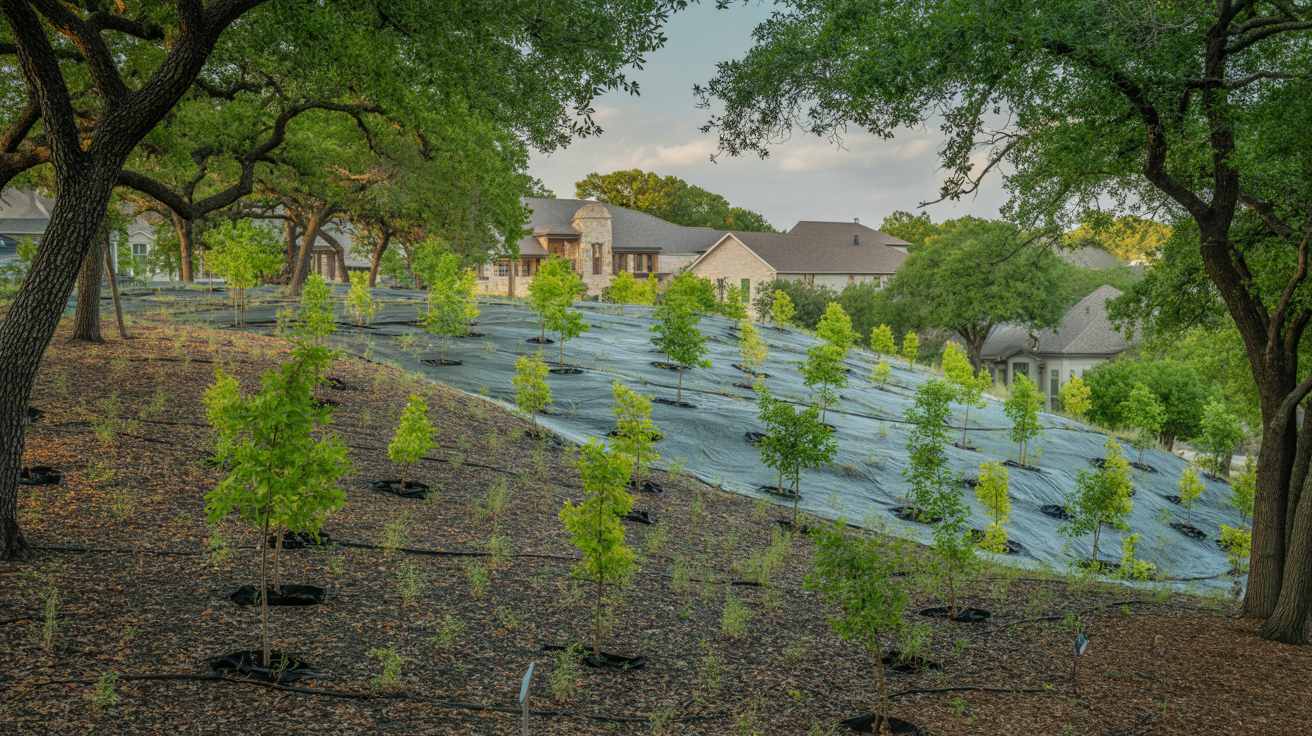
Central Texas soil presents unique challenges. In Marble Falls, you're often dealing with limestone bedrock close to the surface, caliche layers that can block root penetration, and soil pH that runs alkaline. When I dig a planting hole, I'm not just creating a space for the root ball—I'm breaking through compacted layers and creating pathways for roots to spread. The hole needs to be wide, typically two to three times the width of the root ball, but not deeper than the root ball itself. This is crucial: planting too deep is one of the most common mistakes I see, and it kills more trees than almost anything else.
When you remove the tree from its container or burlap, you need to see the root flare—that's where the trunk starts to widen at the base. This root flare should sit right at ground level, maybe even slightly above if you're accounting for settling. If you bury it, you're essentially choking your tree, preventing proper gas exchange and inviting rot and disease.
Here's something that surprises people: don't add amendments to your planting hole. No compost, no fertilizer, no fancy soil mixes. I know it seems counterintuitive, especially when you're looking at rocky, poor-quality native soil, but amended holes create problems. Roots tend to stay in that amended zone rather than spreading into native soil, and you end up with a root-bound tree that never properly establishes. The tree needs to adapt to your actual soil conditions, not the artificial environment you've created in the hole.
Once the tree is positioned correctly, backfill with the native soil you removed. Tamp it down gently to eliminate air pockets, but don't compact it so much that you restrict root growth. Water thoroughly to settle the soil and ensure good root-to-soil contact. Then apply mulch—and this is important—keep it away from the trunk. I use a two to four-inch layer of organic mulch extending out to the drip line, but leave a few inches of bare soil around the trunk itself. Mulch piled against the trunk invites rot, insects, and disease.
Fire Safety Considerations for Tree Placement
Wildfire risk is something every Central Texas property owner needs to take seriously, and your tree choices and placement play a significant role in your home's defensibility. I've worked on properties throughout Texas, and I've seen firsthand how the right vegetation management can make the difference between a home that survives a wildfire and one that doesn't.
Marble Falls guidelines recommend maintaining a thirty-foot zone of low-flammability vegetation around structures. This doesn't mean you can't have trees in this zone—it means you need to choose them carefully and maintain them properly. Native drought-tolerant species tend to have lower flammability than moisture-dependent plants that dry out during our summer droughts. Trees with high resin or oil content, like some conifers, burn hotter and faster than broadleaf trees.
In that defensive zone around your home, space your trees appropriately so fire can't easily jump from crown to crown. Prune lower branches up to about ten feet from the ground—these "ladder fuels" allow ground fires to climb into tree crowns, where they become much more dangerous and harder to control. Keep the area beneath your trees clear of leaf litter, dead branches, and tall grass. I know it looks more natural to leave this material in place, but during fire season, it's fuel waiting for ignition.
Pay special attention to trees near propane tanks, driveways, and other access routes. Emergency vehicles need clear access to your property, and trees that block that access can delay response times. I always consider fire safety alongside aesthetics when I'm planning tree placement—your beautiful landscape isn't worth much if it puts your home at risk.
Irrigation Strategies for Newly Planted Trees
Water management makes or breaks tree establishment in Central Texas. Our climate is unpredictable—we might get fifteen inches of rain in a month during spring, then go months without meaningful precipitation in summer. Your newly planted trees can't handle that variability on their own, at least not in their first few years.
During establishment—roughly the first two growing seasons—your trees need consistent moisture. I recommend about six to eight gallons of water per week per inch of trunk diameter. For a two-inch caliper tree, that's twelve to sixteen gallons weekly. This sounds like a lot, but consider that you're trying to grow an extensive root system that will eventually support a large tree. Shallow, frequent watering encourages shallow roots that make trees vulnerable to drought and wind throw. Deep, less frequent watering encourages roots to grow down into the soil profile where they can access moisture even during dry periods.
Drip irrigation is your most efficient option for trees. I install drip emitters in a ring around the tree at the edge of the planting hole, then move them outward as the tree grows. This delivers water directly to the root zone with minimal evaporation or runoff. Overhead irrigation wastes water through evaporation and can promote foliar diseases, especially during our humid summers.
As your trees mature, you can gradually reduce supplemental irrigation. Native and well-adapted species should eventually require watering only during extreme droughts once they're fully established. This is one of the major advantages of choosing appropriate species—you're not committing to decades of intensive irrigation just to keep your trees alive.
Maintenance Requirements After Planting
Tree planting isn't a one-and-done project. The first two to three years after planting are critical, and the care you provide during this period determines whether your tree becomes a valuable landscape asset or struggles and eventually fails.
Mulch is your tree's best friend during establishment. That two to four-inch layer I mentioned earlier does several important things: it moderates soil temperature, retains moisture, suppresses weeds that compete for water and nutrients, and gradually breaks down to improve soil structure. But mulch breaks down over time, so you'll need to replenish it every couple of years. When you add new mulch, remember to keep it away from the trunk—that "mulch volcano" you see piled up against tree trunks actually kills more trees than it helps.
Pruning needs to be minimal during the first two years. I know the temptation is to shape your tree and remove lower branches immediately, but resist it. Your tree needs all the foliage it can get to produce energy for root growth. Limit pruning to removing dead, broken, or crossed branches that rub against each other. Anything beyond that can stress the tree and slow establishment. Once your tree is established, you can begin selective pruning to develop good structure and remove any branches that pose hazards or interfere with structures.
Monitor your trees regularly for signs of stress, pest problems, or disease. Wilting during hot weather despite adequate water, premature leaf drop, discolored foliage, unusual growths, or excessive dieback all warrant investigation. In Central Texas, Oak Wilt is a serious concern for oak species. If you see symptoms—rapid browning of leaves, starting from the leaf margins and moving inward, often with leaves remaining attached to the tree—contact a certified arborist immediately. Oak Wilt spreads rapidly and can kill entire stands of oaks if not managed properly.
Long-Term Benefits and Property Value
When you plant trees correctly in Marble Falls, you're making an investment that compounds over decades. I've worked on properties where mature trees planted thirty or forty years ago now provide enormous value—shade that reduces cooling costs by twenty to thirty percent, windbreaks that protect structures and reduce heating costs, privacy screening, wildlife habitat, and aesthetic appeal that significantly increases property values.
Trees improve air quality by filtering pollutants and producing oxygen. They reduce stormwater runoff by intercepting rainfall and allowing it to infiltrate slowly into the soil. Their root systems help stabilize soil and prevent erosion, which is particularly valuable in our area where heavy rains can cause significant erosion problems. In urban areas like Marble Falls, trees reduce the heat island effect, making neighborhoods more comfortable and livable during our brutal summers.
But these benefits only materialize if your trees survive and thrive. That's why everything I've discussed—species selection, proper planting, appropriate irrigation, and consistent maintenance—matters so much. A tree planted without regard for local conditions or proper technique is unlikely to provide these long-term benefits. It becomes a liability rather than an asset, requiring eventual removal and leaving you back where you started, but poorer for the experience.
Working With Professionals for Complex Projects
Some tree planting projects are straightforward enough for a knowledgeable property owner to handle independently. Others benefit significantly from professional expertise. At Earth in Motion, we bring construction knowledge and land management experience to every project, and that combination allows us to see potential problems before they become expensive mistakes.
Site conditions drive much of the complexity in tree planting. If you're working with significant slopes, rocky soil, limited access, or proximity to structures and utilities, professional help becomes valuable. We have the equipment to dig through challenging soils, the experience to properly assess drainage and make necessary modifications, and the knowledge to select and place trees for long-term success.
Regulatory compliance is another area where professional guidance helps. If you're working on a project that requires landscape architect sealing, or if you're uncertain whether your plans comply with local ordinances, bringing in someone who regularly works with these requirements can save you headaches and delays. We've navigated countless permitting processes and know what documentation is required, what timeline to expect, and how to avoid common pitfalls that slow projects down.
Cost factors in tree planting vary widely based on tree size, site conditions, access constraints, irrigation infrastructure needs, and whether professional design and installation are required. Larger specimen trees cost more to purchase and require specialized equipment to move and plant. Rocky soil or limited access increases labor requirements. Drip irrigation systems add upfront cost but reduce long-term water expenses. These are all considerations we discuss openly with clients so they understand what drives pricing and can make informed decisions about their projects.
Making Tree Planting Work for Your Property
Every property in Marble Falls is unique. Your soil conditions, sun exposure, wind patterns, existing vegetation, and goals for your landscape all influence what trees will work best for you. Some clients want maximum shade for cooling and energy savings. Others prioritize privacy screening or wildlife habitat. Some are focused on minimizing maintenance and water use, while others are willing to invest more effort for specific aesthetic outcomes.
The key is matching your tree selection and placement to your specific situation and goals. This means spending time evaluating your property before you plant anything. Walk your land at different times of day and notice where sun and shade fall, where wind hits hardest, where water naturally flows or pools. Think about how your property will be used—where you need clear sight lines for safety, where you want screening for privacy, where shade will be most valuable.
Consider mature tree size in relation to your available space. A Live Oak that eventually spreads forty feet wide might be perfect for a large rural property but completely inappropriate for a small urban lot. Think about seasonal characteristics—do you want evergreen trees for year-round screening, or deciduous trees that provide summer shade but allow winter sun? Are you willing to deal with significant leaf drop, or do you prefer cleaner species?
Don't forget about integration with other landscape elements. Trees shouldn't exist in isolation—they're part of a larger landscape that includes shrubs, ground covers, grasses, and hardscape elements. Your trees should complement these other components and work together to create a cohesive, functional landscape. This is where having a plan before you start planting becomes important. I've seen too many properties where trees were planted randomly over years without any overall vision, resulting in awkward spacing, conflicting purposes, and maintenance headaches.
Community and Environmental Stewardship
When you plant trees in Marble Falls, you're participating in something larger than your individual property improvement. You're contributing to the community's tree canopy, which benefits everyone through improved air quality, reduced heat, and enhanced aesthetics. You're providing habitat for birds, pollinators, and other wildlife that make our area special. You're helping manage stormwater and reduce erosion.
Marble Falls recognizes this community value through events like Texas Arbor Day celebrations where residents come together to plant trees in public spaces. These events remind us that trees are a shared resource and a shared responsibility. The trees we plant today will be enjoyed by future generations—our children and grandchildren will benefit from the shade and beauty we create now.
This long-term perspective should inform your tree planting decisions. Choose species that will still be valuable fifty or a hundred years from now. Plant them in locations where they can grow to maturity without threatening structures or infrastructure. Maintain them properly so they remain healthy and safe. Think beyond your own immediate needs and consider how your trees will contribute to the larger landscape over time.
Final Thoughts on Successful Tree Establishment
After two decades of working with land in Central Texas, I've come to deeply respect the relationship between trees and the environments they inhabit. Trees aren't decoration—they're living organisms that require specific conditions to thrive. When we honor those requirements and work with rather than against the land, trees reward us with decades of benefits and beauty.
Success in tree planting comes down to three fundamental principles: choose appropriate species, plant them correctly, and provide proper care during establishment. Everything else is detail and refinement. If you get these basics right, your trees have an excellent chance of becoming valuable long-term assets. Get them wrong, and you're setting yourself up for disappointment and eventual tree loss.
Don't rush the process. Take time to plan, to understand your site conditions, to select trees that match your goals and constraints. If you're uncertain about any aspect of the project, seek guidance from professionals who understand both trees and local conditions. The cost of getting expert input on the front end is minimal compared to the cost of replacing failed trees or dealing with problems that arise from poor planning.
Remember that tree planting is an investment in your property's future and in the broader community. The trees you plant today will still be growing long after we're gone, providing shade, beauty, habitat, and environmental benefits to people we'll never meet. That's a legacy worth doing right, and it starts with understanding what tree planting in Marble Falls really requires and committing to providing it.
Frequently Asked Questions About Tree Planting in Marble Falls
Do I need approval to plant trees on my Marble Falls property?
Yes, in many cases you do need approval, especially for areas under city jurisdiction or regulated zones. Marble Falls requires that trees planted in public or regulated areas come from the city's approved species list. If you want to plant species not on that list, you'll need landscape plans sealed by a registered Texas Landscape Architect. At Earth in Motion, I help clients navigate these requirements and ensure compliance with local ordinances. We handle the documentation process and work within approved species guidelines to avoid delays and complications. I always recommend checking regulations before starting any tree planting project to prevent costly mistakes down the line.
Which trees work best in Marble Falls' climate and soil conditions?
Native and well-adapted species consistently perform best in our Central Texas environment. I recommend trees like Live Oak, Cedar Elm, Bald Cypress, and Texas Red Oak because they're naturally suited to our limestone bedrock, alkaline soils, and unpredictable rainfall patterns. At Earth in Motion, I've planted hundreds of these species over 20 years, and they consistently outperform non-native trees in drought tolerance and survival rates. The key is matching tree selection to your specific site conditions—soil type, sun exposure, space constraints, and mature size requirements. I evaluate these factors on every property to ensure the trees we plant will thrive for decades rather than struggle and eventually fail.
How do I properly plant trees to ensure they survive and thrive?
Proper planting technique is critical for long-term tree success, and it's an area where my construction background at Earth in Motion really makes a difference. The planting hole should be two to three times wider than the root ball but never deeper—planting too deep kills more trees than almost any other mistake. The root flare must be visible at ground level, and you should never add soil amendments or fertilizer to the planting hole. I use native soil for backfilling and apply 2-4 inches of organic mulch around the tree, keeping it away from the trunk. Before any digging, we always call 811 to locate underground utilities, and we carefully consider spacing from structures and power lines to prevent future problems.
What maintenance do newly planted trees need during their first few years?
The first two to three years after planting are critical for tree establishment, and proper maintenance during this period determines long-term success. At Earth in Motion, I set up drip irrigation systems that deliver about 6-8 gallons per week per inch of trunk diameter during establishment. Deep, infrequent watering encourages proper root development better than shallow, frequent watering. Mulch needs replenishing every couple of years, and I limit pruning to only dead, broken, or crossed branches during the establishment period. Regular monitoring for stress, pest problems, or diseases like Oak Wilt is essential. The care you provide during these early years creates the foundation for decades of tree health and benefits.
How much does professional tree planting cost, and what factors affect pricing?
Tree planting costs vary significantly based on several key factors that I evaluate during every Earth in Motion project consultation. Tree size is a major driver—larger specimen trees cost more to purchase and require specialized equipment for installation. Site conditions heavily influence pricing: rocky soil, limited access, significant slopes, or proximity to structures increases labor requirements and complexity. Irrigation infrastructure needs, soil preparation requirements, and regulatory compliance all factor into final costs. Projects requiring landscape architect sealing or extensive site preparation naturally cost more than straightforward installations. I provide transparent cost discussions so clients understand what drives pricing and can make informed decisions about their specific project goals and constraints.
Hire Us