Spicewood Tree Planting Guide: Timing, Species & Costs
Tree Planting in Spicewood: What You Need to Know Before You Dig
Tree planting in Spicewood isn't just about digging a hole and dropping in a sapling—it's about understanding your land, respecting the local environment, and making smart decisions that will pay off for decades to come. I'm Chad Burnell, founder of Earth in Motion, and over my 20 years in construction and land development across Central Texas, I've seen countless property owners make costly mistakes with tree planting simply because they didn't know what questions to ask. Whether you're establishing a new landscape on your Spicewood property or replacing trees you've lost to drought or disease, the difference between a thriving canopy and a dead investment comes down to preparation, timing, and understanding what this unique Hill Country environment demands.
What makes tree planting around Spicewood different from other regions? Everything. Our rocky limestone soils, unpredictable rainfall, scorching summers, and occasional hard freezes create challenges you won't face in other parts of the country. But here's the good news: when you work with the land instead of against it, you can establish beautiful, healthy trees that will increase your property value, provide shade, and become part of the landscape legacy you leave behind. Let me walk you through what actually works out here.
Why Timing Matters More Than You Think
I've had clients call me in July asking to plant trees, and I have to be honest with them—you're setting yourself up for failure. The Central Texas heat is brutal, and asking a newly planted tree to establish roots while temperatures soar past 100 degrees is like asking someone to run a marathon in a sauna. It's possible, but why make it harder than it needs to be?
The window for successful tree planting in our area runs from October through March, and there's solid science behind this. During fall and winter, trees go dormant. They're not trying to push out new leaves or support active growth. Instead, all their energy goes underground into root development. This is exactly what you want. Those roots are establishing themselves, spreading out, and preparing to support the tree when spring arrives and growth kicks into high gear.
Here's what I've observed working on properties throughout the Spicewood area: trees planted in November through February consistently outperform trees planted at other times of the year. The soil still has moisture from fall rains, temperatures are moderate, and the tree isn't fighting the stress of summer heat. You're also giving that tree several months to develop a root system before it faces its first Texas summer. That head start makes all the difference.
What Happens When You Plant Off-Season
I won't tell you it's impossible to plant trees outside this window, but you need to understand what you're committing to. Spring planting can work if you're prepared for intensive watering and monitoring. Summer planting? That's a high-risk gamble that requires almost daily attention and significant water investment. Even with careful management, survival rates drop considerably when you're planting in heat and drought conditions.
At Earth in Motion, we plan our tree planting projects around this October-to-March window because we want your investment to succeed. We've developed relationships with local nurseries who understand Central Texas conditions and can supply us with healthy, well-adapted specimens during the optimal planting season. This isn't about making our job easier—it's about setting your trees up for long-term success.
Choosing Species That Actually Thrive in Spicewood
Walk through any established neighborhood in the Austin area and you'll notice something: the healthiest, most beautiful trees are almost always native or well-adapted species. There's a reason for this. These trees evolved to handle our conditions. They know how to survive on limited water, they're adapted to our alkaline soils, and they can handle the temperature swings we experience.
When I'm working with clients on tree selection, I focus on native Texas species that have proven themselves in this region. Live Oak is the gold standard—slow-growing, drought-tolerant once established, and incredibly long-lived. Cedar Elm adapts to various soil conditions and provides excellent shade. Bald Cypress surprises people because they associate it with swamps, but it's remarkably adaptable and can handle our dry periods once established. Texas Red Oak offers beautiful fall color and grows relatively quickly for an oak species.
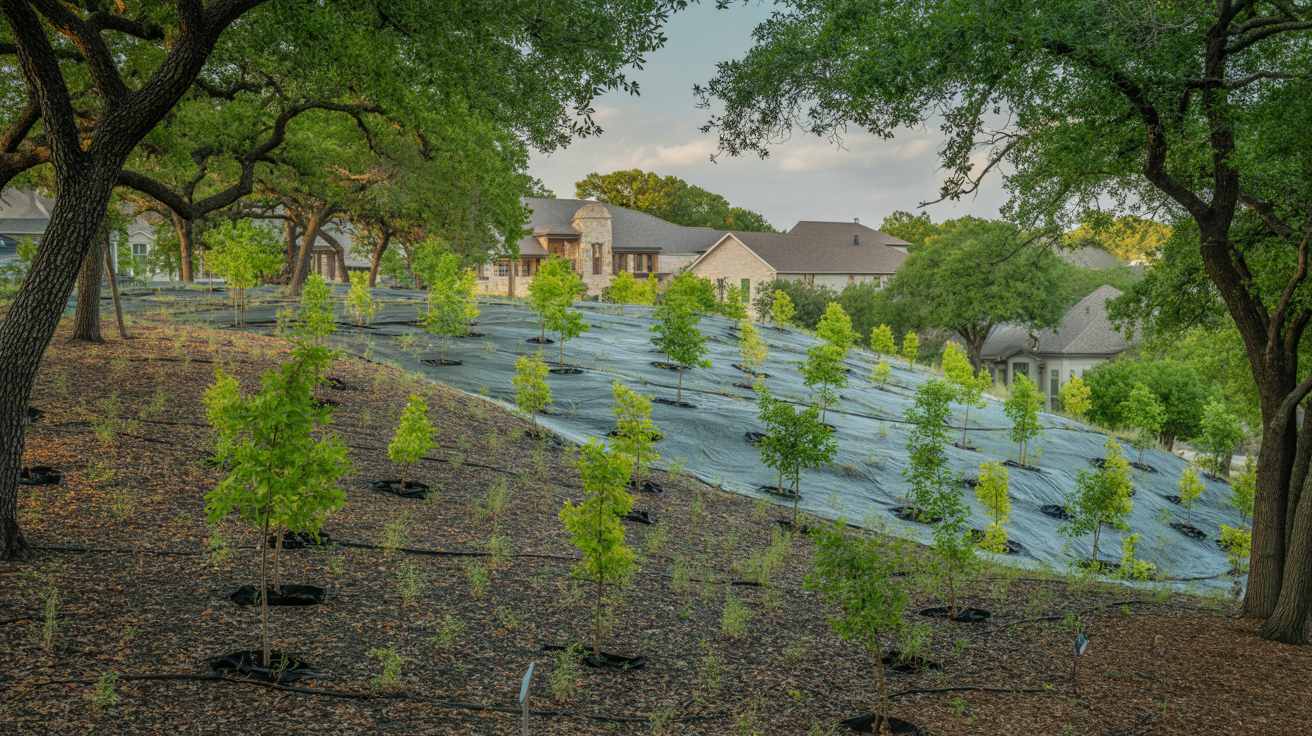
I also recommend species based on your specific property conditions. If you've got a low-lying area that holds moisture, that's perfect for Bald Cypress or Sycamore. Rocky, well-drained slopes? That's where Live Oak and Cedar Elm shine. The key is matching the tree to your site rather than forcing a species to survive where it doesn't naturally belong.
Avoiding the Mistakes I See All the Time
Here's where property owners get into trouble: they fall in love with a tree species that simply isn't suited for Central Texas conditions. I've seen people plant water-loving species on hilltops with thin soil, wondering why their tree struggles year after year. Or they'll choose a fast-growing species without considering the mature size, and ten years later they're dealing with trees that interfere with power lines or threaten their home's foundation.
Part of what we do at Earth in Motion is help you think long-term. We're not just planting a tree—we're establishing what will become a major landscape feature for decades. That means considering mature height and spread, root behavior, water requirements, and how the tree fits into your overall property plan. When I walk a property with a client, I'm thinking about sun exposure, drainage patterns, existing vegetation, and how everything will look fifteen or twenty years down the road.
The Site Preparation Work Nobody Talks About
Here's what separates successful tree planting from the attempts that fail within the first year: proper site preparation. Most people focus on the tree itself and completely overlook the foundation you're creating for it. In my experience working throughout Central Texas, the site prep work is where you either set yourself up for success or guarantee problems down the road.
First, you need to understand what you're working with. Central Texas soil is notoriously challenging. We've got shallow soil over limestone bedrock in many areas, alkaline pH that can limit nutrient availability, and soil that either drains too quickly or, in low-lying areas, not quickly enough. Before you plant anything, you need to know what you're dealing with. This means looking at drainage patterns during rain events, understanding your soil depth and composition, and identifying any potential obstacles like utility lines or existing root systems.
I remember working on a property near Lake Travis where the client wanted to establish a grove of trees on what looked like a perfect hillside location. When we excavated the first planting hole, we hit solid limestone eighteen inches down. That completely changed our approach. We couldn't just dig standard holes—we had to evaluate each planting location individually, sometimes using equipment to break through rock layers, and in some cases, we relocated trees to areas with better soil depth. That kind of site assessment and adaptation is what makes the difference between thriving trees and stunted growth.
Understanding Your Soil and Water
The limestone-based soils around Spicewood create specific challenges for tree establishment. The high pH can tie up certain nutrients, making them unavailable to plants even when they're present in the soil. This is why choosing species adapted to alkaline conditions is so critical—they've evolved mechanisms to access nutrients in these conditions.
Water management is equally important. Our rainfall is unpredictable at best. We might get ten inches in a week during spring, then nothing for two months in summer. Trees need consistent moisture during establishment, which means you can't rely on natural rainfall alone. At the same time, poor drainage can kill a tree just as quickly as drought. We've learned to evaluate drainage patterns carefully, sometimes modifying the immediate planting area to ensure water doesn't pool around the root zone during heavy rains.
The Planting Process That Actually Works
After two decades of construction work and countless tree planting projects, I've developed a process that maximizes survival rates. It starts with excavation. The hole needs to be wide—at least two to three times the diameter of the root ball—but not too deep. You want the root flare (where the trunk meets the roots) to sit slightly above the surrounding grade. This prevents the trunk from sitting in water and reduces the risk of rot.
Here's something most people get wrong: they think trees need heavily amended soil. In reality, you want to backfill with native soil or a mix that's mostly native soil. Why? Because you want the roots to adapt to the conditions they'll face for the rest of their life. If you create a planting pocket full of rich, amended soil, the roots will stay in that zone rather than spreading out into the surrounding native soil. Those trees might look good initially, but they'll struggle long-term because they never developed an extensive root system.
The exception is if your native soil is severely compacted or completely unsuitable. In those cases, we'll work to improve the soil structure and drainage, but we do it gradually and we make sure we're creating conditions the tree can adapt to, not artificial conditions that can't be sustained.
Water, Mulch, and Protection
Immediately after planting, water is critical. We're talking deep, thorough watering that penetrates the entire root zone. Not a light sprinkling—you need to soak the soil so water reaches deep into the planting area. This settles the soil around roots, eliminates air pockets, and gives the tree the moisture it needs to begin recovering from transplant stress.
Mulch is your friend, but it needs to be applied correctly. We use a three-to-four-inch layer of natural mulch spread in a circle around the tree, keeping it several inches away from the trunk itself. This mulch layer regulates soil temperature, retains moisture, suppresses weeds, and gradually breaks down to improve soil quality. What we don't do is create "mulch volcanoes" piled up against the trunk—that's an invitation for rot, disease, and pest problems.
Physical protection matters too, especially in areas with deer or where equipment operates nearby. I've seen trees survive drought only to be killed by a careless lawnmower strike or browsing deer. Simple protection measures during the establishment period can prevent these losses.
The Two-Year Commitment Nobody Warns You About
Here's the truth about tree planting that nobody wants to hear: your work isn't done when the tree is in the ground. In fact, that's just the beginning. The first two years after planting are absolutely critical for tree survival and long-term health. This is the establishment period, and how you manage it determines whether your tree thrives or merely survives.
During this time, consistent watering is non-negotiable. Even native, drought-tolerant species need regular water while establishing their root systems. In the hot, dry conditions we experience around Spicewood, this typically means deep watering weekly during the growing season, more frequently during extreme heat. You're not just keeping the tree alive—you're supporting root growth that will eventually allow the tree to access deep soil moisture on its own.
At Earth in Motion, when we take on tree planting projects, we educate our clients about this two-year reality. Some clients want us to handle the ongoing maintenance, which we're equipped to do. Others prefer to manage it themselves once they understand what's required. Either way, the commitment is the same—consistent attention and care until the tree is truly established.
Monitoring and Adjusting Your Approach
Trees communicate their needs if you know what to look for. Wilting leaves, premature leaf drop, discoloration, or stunted growth all signal problems. Sometimes it's water stress. Sometimes it's too much water. Occasionally it's pest or disease issues, though native species planted in appropriate locations typically have few problems once established.
I've learned to read landscapes over the years, and one thing I always tell clients: if something doesn't look right, it probably isn't. Don't wait until a tree is clearly dying to address problems. Early intervention almost always produces better outcomes than waiting until you have a crisis.
Navigating Regulations and Permits in the Spicewood Area
One aspect of tree planting that surprises many property owners is the regulatory framework around tree management. While planting trees generally faces fewer restrictions than removing them, you still need to understand the rules, especially if you're working on a larger project or in a development with specific landscape requirements.
In the greater Central Texas region, tree protection ordinances typically focus on existing trees, particularly large, established specimens that provide significant environmental benefits. These protected trees are usually defined by trunk diameter—commonly 19 inches or larger measured at a specific height above ground. Some jurisdictions also designate heritage trees that receive additional protection based on species, age, and size.
For tree planting specifically, regulations usually come into play in a few situations. If you're undertaking development or construction activities, you may need a documented landscape plan that specifies what you're planting and where. This ensures that new construction includes appropriate tree coverage and doesn't negatively impact protected existing trees. Similarly, if you're planting trees as mitigation for removed trees, you'll need to document species, locations, and sizes to satisfy regulatory requirements.
Working With Rather Than Against Local Requirements
In my years of construction and land development work, I've learned that understanding and working within regulatory frameworks makes projects run smoother. We've developed relationships with local planning departments and understand what documentation they need and when they need it. This knowledge prevents delays and ensures projects meet all requirements from the start.
For property owners, the key takeaway is this: before undertaking significant tree planting or removal work, check with your local jurisdiction about permit requirements. In the Spicewood area, this typically means contacting Burnet County or, if you're within municipal boundaries, the appropriate city department. A quick conversation up front can prevent complications later.
Understanding What Drives Tree Planting Costs
When clients ask me about tree planting costs, they're often surprised by the range of factors that influence the final price. It's not as simple as counting trees and multiplying by a number. Every project is unique, and the conditions we're working with make a significant difference in what's required.
Site conditions are probably the biggest variable. A property with deep, workable soil and good access is straightforward to work with. We can move efficiently, excavate easily, and complete the work without major obstacles. Compare that to a rocky hillside property where we're breaking through limestone, working on slopes, and carefully managing equipment to avoid damage to existing landscape features. The difference in labor, equipment needs, and time required is substantial.
Tree size and species selection also impact costs. A small containerized tree is relatively easy to transport and plant. A large specimen tree with a massive root ball requires specialized equipment, careful handling, and more extensive site preparation. Native species from local growers are typically more accessible and cost-effective than specialty varieties that need to be sourced from distant nurseries.
The Value of Professional Site Assessment and Preparation
One aspect of tree planting that often gets overlooked in initial cost discussions is the value of proper site assessment and preparation. Yes, you can hire someone to just dig holes and stick trees in the ground. But will those trees survive and thrive? That's a different question entirely.
What Earth in Motion brings to tree planting projects is two decades of experience reading Central Texas landscapes. When we assess a site, we're evaluating drainage, soil conditions, sun exposure, wind patterns, and how all these factors interact. We're thinking about utility line locations, access for future maintenance, and how your tree planting fits into your overall property development plans.
This front-end work might seem like an added cost, but it's actually an investment that prevents expensive failures. A tree that dies within the first year represents a complete loss—you paid for the tree, paid for the planting, and you have nothing to show for it. Proper assessment and preparation dramatically improves survival rates, which means your investment actually delivers the benefits you're paying for.
Making Tree Planting Part of Your Larger Property Vision
At Earth in Motion, we don't just plant trees—we help clients develop comprehensive solutions for their properties. Tree planting often connects to other land development work we do, whether that's building ponds, managing drainage, creating access roads, or establishing wildlife habitat. Understanding these connections allows us to create integrated solutions that work together rather than conflicting systems that create problems down the road.
For example, I've worked on properties where we're building a pond and simultaneously establishing trees around the watershed. The pond location influences where we plant trees, and the trees we select influence how we manage runoff and erosion. These aren't separate projects—they're connected elements of a comprehensive land management approach.
Similarly, if you're planning a custom pond (one of my particular passions), the trees you plant around it will influence water quality, shade coverage, wildlife habitat, and the overall aesthetic of the completed project. Planning these elements together from the start produces better outcomes than treating them as isolated projects.
Learning From Colorado and Applying It to Texas
My construction experience includes time working in Colorado, where I learned valuable lessons about working with challenging environmental conditions. The high-altitude, dry Colorado climate taught me a lot about plant stress, water management, and the importance of choosing species adapted to local conditions. While Central Texas and Colorado are obviously different environments, some principles carry over.
Both regions face water limitations. Both experience temperature extremes. Both have soils that require understanding and adaptation rather than brute-force amendment. The specific solutions differ, but the underlying approach remains consistent: work with the environment, choose adapted species, and invest in proper establishment practices.
Your Tree Planting Success Starts With Understanding Your Property
After 20 years in this business, I can tell you that successful tree planting starts with realistic expectations and proper preparation. The trees that thrive are the ones planted in appropriate locations, during optimal seasons, with species well-suited to the site conditions. The trees that fail are usually the result of poor planning, inappropriate species selection, or inadequate establishment care.
If you're considering tree planting on your Spicewood property, start by understanding what you're working with. Walk your property and observe where water flows during rain events. Note which areas receive full sun versus partial shade. Look at your soil—is it rocky and shallow, or deeper and more workable? These observations will guide species selection and planting locations.
Think about your long-term vision for the property. Where do you want shade in ten years? Are you trying to create privacy screening? Do you want to attract wildlife? Are you establishing windbreaks or erosion control? Clear objectives help guide the tree selection and placement process.
Why Earth in Motion Approaches Tree Planting Differently
What sets Earth in Motion apart isn't just my 20 years of construction experience or our status as a Service-Disabled Veteran-Owned Small Business. It's our approach to problem-solving and our commitment to solutions that actually work in Central Texas conditions. We've seen what succeeds and what fails in this region, and we apply that knowledge to every project we take on.
When you work with us on a tree planting project, you're getting more than labor and equipment. You're getting site assessment based on decades of land development experience. You're getting species recommendations drawn from observing what actually thrives around Spicewood and the broader Central Texas region. You're getting planting techniques proven to maximize survival rates in our challenging conditions. And you're getting honest communication about what's required for success, including the two-year establishment commitment that makes the difference between surviving trees and thriving ones.
We're not the cheapest option, and we're fine with that. We're the option for property owners who want their tree planting investment to succeed, who understand that proper preparation and quality work deliver better long-term value than cutting corners up front.
Moving Forward With Your Tree Planting Plans
If you're ready to move forward with tree planting on your Spicewood property, the best time to start planning is now. Even if you're not planting until next fall's optimal window, starting the conversation early gives us time to assess your site, help you select appropriate species, and develop a comprehensive plan that fits your property vision and budget.
Remember that tree planting is an investment in your property's future. The trees you establish now will provide shade, increase property values, support wildlife, and become defining features of your landscape for decades to come. That kind of long-term benefit deserves thoughtful planning and quality execution.
At Earth in Motion, we've built our reputation on delivering solutions that work. Whether we're building custom ponds, managing complex site development challenges, or establishing trees that will outlive all of us, we approach every project with the same commitment to quality and integrity. Your success is our success, and we take that responsibility seriously.
Tree planting in Spicewood demands local knowledge, proper timing, species selection matched to site conditions, and a commitment to establishment care—all aspects where Earth in Motion's experience and approach to land development can turn your vision into thriving reality for generations to come.
Tree Planting in Spicewood: 5 Most Asked Questions
When is the best time to plant trees in Spicewood?
The optimal window for tree planting in the Spicewood area runs from October through March. During this period, trees go dormant and focus their energy on root development rather than supporting active growth. This gives your trees several months to establish a strong root system before facing their first Texas summer. At Earth in Motion, I've consistently observed that trees planted during this window dramatically outperform those planted during other times of the year. While spring planting can work with intensive care, summer planting requires almost daily attention and significantly higher water investment, with much lower survival rates.
Which tree species actually thrive in Central Texas conditions around Spicewood?
Native and well-adapted species consistently perform best in our challenging Hill Country environment. Live Oak is the gold standard—drought-tolerant once established and incredibly long-lived, though slow-growing. Cedar Elm adapts to various soil conditions and provides excellent shade. Bald Cypress surprises many people but handles our dry periods remarkably well once established. Texas Red Oak offers beautiful fall color and grows relatively quickly for an oak species. At Earth in Motion, I match species to your specific site conditions—Live Oak and Cedar Elm for rocky, well-drained slopes, Bald Cypress for low-lying areas that hold moisture. The key is working with your land's natural characteristics rather than fighting against them.
What site preparation work is actually necessary for successful tree planting?
Proper site preparation is where most tree planting projects succeed or fail, and it goes far beyond digging a hole. I start by evaluating your soil depth and composition, drainage patterns during rain events, and potential obstacles like utility lines or bedrock. In the Spicewood area, we often encounter shallow soil over limestone bedrock, which completely changes our approach. Sometimes we need equipment to break through rock layers, or we relocate planting sites to areas with better soil depth. The planting hole needs to be wide—two to three times the root ball diameter—but not too deep, with the root flare sitting slightly above grade. We backfill with mostly native soil because you want roots to adapt to the conditions they'll face long-term, not stay confined to an artificial planting pocket.
What kind of ongoing care do newly planted trees need to survive?
The first two years after planting are absolutely critical, and this commitment surprises many property owners. Even drought-tolerant native species need consistent water while establishing their root systems. This typically means deep weekly watering during the growing season, more frequently during extreme heat. You're not just keeping the tree alive—you're supporting root growth that will eventually allow the tree to access deep soil moisture independently. I also apply a three-to-four-inch layer of mulch around each tree, keeping it away from the trunk to regulate soil temperature and retain moisture. At Earth in Motion, I educate clients about this two-year reality because how you manage this establishment period determines whether your investment thrives or merely survives.
What factors influence the cost of a professional tree planting project?
Site conditions are the biggest variable affecting project costs. A property with deep, workable soil and good access allows us to work efficiently. Compare that to a rocky hillside where we're breaking through limestone and working on slopes—the difference in labor, equipment needs, and time is substantial. Tree size and species selection also impact costs, with large specimen trees requiring specialized equipment and more extensive site preparation compared to smaller containerized trees. The value Earth in Motion brings is comprehensive site assessment and preparation based on 20 years of Central Texas experience. This front-end investment dramatically improves survival rates, preventing the complete loss that occurs when trees die within the first year. Proper assessment and preparation ensure your investment delivers the long-term benefits you're paying for.
Hire Us