Bee Cave Tree Planting Rules and Requirements Guide
Tree planting in Bee Cave isn't just about putting a sapling in the ground and hoping for the best—it's a carefully regulated process that requires understanding local ordinances, choosing the right species for Central Texas conditions, and executing proper planting techniques that give your trees the best chance to thrive for decades. I'm Chad Burnell, founder of Earth in Motion, Inc., and over my 20 years in construction and land development across Texas, I've learned that successful tree planting comes down to knowing what the city requires, what the land can support, and how to do the work right the first time.
Understanding Bee Cave's Tree Preservation and Planting Rules
Before you plant a single tree in Bee Cave, you need to understand that this community takes its tree canopy seriously. The city has put together a comprehensive set of rules designed to preserve existing trees while ensuring new plantings contribute to the overall landscape. These regulations affect everyone from homeowners adding shade to their backyard to developers planning entire subdivisions.
Here's what most people don't realize: Bee Cave requires you to preserve or replace at least 60% of the caliper inches of trees that existed on your property before any development work begins. Caliper inches refer to the diameter of a tree trunk measured at a specific height. This isn't about tree count—it's about the total size of the trees you're working with. If you remove a large oak, you can't just replace it with a couple of small saplings and call it even. The math has to add up based on trunk diameter, and the city tracks this carefully.
Now, there are exceptions to this rule. Certain species don't count toward your preservation requirement at all. These exempted trees include Hackberry, Eastern Red Cedar, Chinaberry, Ashe Juniper, Mesquite, and Ligustrum. Why these specific species? Some are considered invasive or problematic, while others are so common that the city doesn't prioritize their preservation the same way they do native hardwoods and significant specimen trees.
The Credit System That Determines Your Planting Requirements
Bee Cave uses a credit system that rewards you for keeping larger, more valuable trees on your property. When you preserve a tree instead of removing it, you earn credits based on its size category. A protected tree measuring between 4 and 7.9 inches in diameter earns you a 0.75 to 1 credit ratio. Move up to a significant tree at 8 to 11.9 inches, and you get a straight 1 to 1 credit. Specimen trees between 12 and 23.9 inches earn you 1.15 credits per inch, and heritage trees over 24 inches diameter get you 1.25 credits per inch.
What this means in practical terms: if you can save that massive old oak on your property, it offsets a significant portion of your new planting requirements. I've worked on projects where strategic preservation of a few large trees eliminated the need to plant dozens of smaller ones, saving both money and effort while maintaining the property's mature character.
When you do need to plant new trees, the city typically requires a minimum caliper of 3 inches. This isn't arbitrary—smaller trees struggle to establish in our Texas heat and limestone soils, while trees below this size take years longer to provide meaningful canopy coverage and visual impact. You're also looking at specific planting density requirements based on your property's zoning and the type of buffers required.
Choosing Species That Actually Survive in Bee Cave
I've seen plenty of beautiful trees die within their first two summers in Central Texas because someone chose the wrong species for our conditions. Bee Cave sits right in the Hill Country, which means we're dealing with shallow limestone soils, extended drought periods, occasional hard freezes, and a disease called oak wilt that devastates certain tree species. Your tree selection has to account for all of this, or you're wasting your time and money.
Cedar Elm stands out as one of the most reliable choices for our area. This native tree handles our limestone soil naturally, resists oak wilt disease, and once established, tolerates drought remarkably well. I've planted Cedar Elms on commercial properties and residential developments throughout the Austin area, and their survival rate beats almost anything else we put in the ground. They also provide excellent screening and shade coverage, which matters when you're trying to meet those buffer requirements the city mandates.
Live Oak varieties, particularly Escarpment Live Oak, represent another solid option for Bee Cave plantings. These trees evolved specifically for our Hill Country limestone environment. They develop deep root systems that access water and nutrients other species can't reach. The trade-off is that they grow more slowly than some alternatives, but what you get is a tree that can survive decades of Texas weather extremes without constant intervention.
Species to Approach Carefully or Avoid Altogether
Not every tree you see at the nursery belongs in Bee Cave. Some species marketed as "drought tolerant" still struggle in our specific combination of alkaline soil and temperature swings. Others grow aggressively and create maintenance headaches down the line. I generally steer clients away from certain non-native species that look great in the container but underperform once they're dealing with our real-world conditions.
Arizona Ash, for example, grows quickly and provides nice shade, but it's also prone to storm damage and has a relatively short lifespan compared to native alternatives. Bradford Pear looks beautiful when it blooms, but it has weak branch structure and often splits apart during ice storms—something we see more often than people expect in Central Texas. These might work in other regions, but in Bee Cave, you're better off selecting species that evolved here.
The disease resistance factor matters more here than in many other regions. Oak wilt moves through interconnected root systems and can wipe out entire groves of Red Oak, Spanish Oak, and certain other oak species. If you're planting oaks in Bee Cave, you need to select varieties with proven resistance and understand how to prevent disease transmission. This isn't optional—it's the difference between a tree that lives 50 years and one that dies in five.
Site-Specific Requirements for Commercial and Residential Projects
The planting requirements in Bee Cave change dramatically based on what you're building and where it sits. A residential lot has different buffer standards than a commercial parking lot, and those standards affect everything from how many trees you need to plant to what size they must be at installation. Understanding these distinctions before you start digging is critical.
Commercial parking lots face some of the strictest requirements. The city mandates that tree canopy must shade at least 25% of the total parking area. They calculate this based on the mature canopy spread of the species you plant, not the size at installation. A newly planted tree only counts for 75% of its projected mature canopy when you're running these numbers, while a preserved existing tree counts at 100%. This is why I always walk a commercial site before anything gets cleared—sometimes saving a few established trees eliminates the need to plant 20 or 30 new ones.
The math on this gets complex quickly. You need to know the mature canopy diameter for each species you're considering, multiply that by the number of trees, apply the 75% factor for new plantings, and demonstrate that your total coverage meets or exceeds the 25% threshold. Get it wrong, and you're replanting or paying penalties after the fact.
Integrating Trees with Stormwater Features
Here's where my experience building custom ponds and managing water features comes directly into play. Bee Cave requires that detention and retention ponds be integrated into your overall landscape design, not just dug as isolated utility features. The city wants to see vegetative screening, natural rock work, and berms that make these water management systems look like intentional landscape elements.
This integration requirement actually creates opportunities. You can count trees planted around properly designed stormwater ponds toward both your landscaping requirements and your buffer obligations if you design the system correctly. I've built projects where the pond berms and perimeter plantings satisfied up to 100% of certain buffer requirements because we integrated everything from the beginning rather than treating them as separate site elements.
The key is understanding how water moves across your site, where the pond needs to be positioned for effective stormwater management, and how to grade the surrounding area to support tree health while meeting engineering requirements. Trees placed in constantly saturated soil fail just as quickly as those planted in perpetually dry conditions. Species selection matters here too—Bald Cypress handles periodic inundation that would kill a Live Oak, while Cedar Elm tolerates drainage transitions better than many alternatives.
Proper Planting Techniques That Actually Work in Central Texas
I've watched plenty of landscape crews plant trees exactly the way they learned in other regions, only to have those trees struggle or die within a year. Central Texas requires some specific adjustments to standard planting practices, and cutting corners on these details costs you money and time when you're forced to replant.
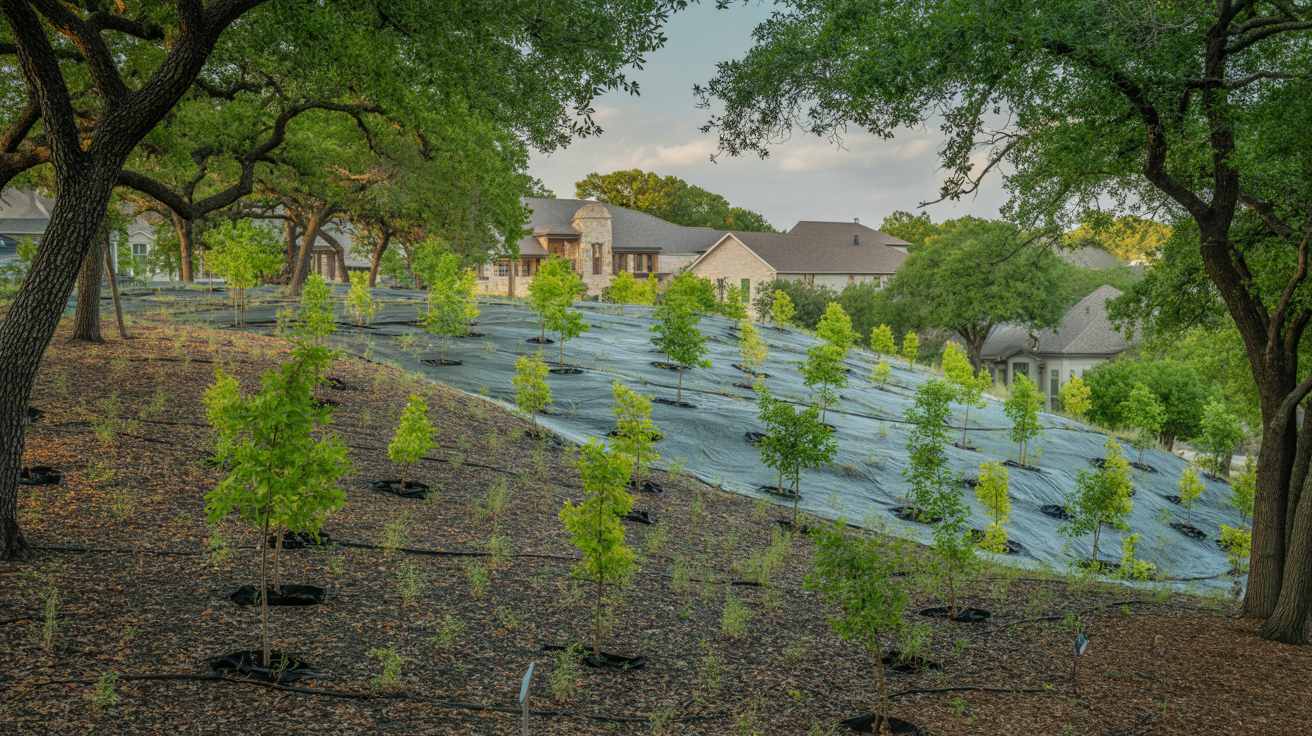
The hole you dig matters more than most people realize. You need to go at least two to three times the width of the rootball, but here's what's critical—don't make the sides smooth. Rough, irregular hole sides encourage roots to penetrate outward into native soil. Smooth sides, especially in our clay and limestone conditions, can create a barrier that roots struggle to cross. I've pulled up dead trees where the roots were still circling inside the planting hole years after installation because they never broke through into the surrounding soil.
Depth is where I see the most common mistakes. Most people plant too deep, burying the root flare where the trunk transitions to roots. That root flare needs to sit at or slightly above the surrounding soil level. When it's buried, the tree struggles to take up oxygen through the bark at the base of the trunk, and over time this leads to decline and death. In our heavy soils, this problem accelerates because water doesn't drain away from the buried trunk section.
Mulching and Watering Strategies for Tree Establishment
Mulch serves multiple critical functions in our climate, but it has to be applied correctly or it causes more problems than it solves. You want a 3-inch layer of hardwood mulch or pine straw extending out to at least the edge of the rootball, preferably beyond. This layer moderates soil temperature, retains moisture, and suppresses competing weeds. But—and this is crucial—keep the mulch 3 to 4 inches away from the trunk itself. Mulch piled against bark creates conditions for rot and provides habitat for insects that damage trees.
I see "mulch volcanoes" all over Austin and Bee Cave—huge piles of mulch stacked up around tree trunks like little mountains. This looks tidy, but it's slowly killing the trees. The bark stays perpetually damp, fungal problems develop, and rodents burrow into the pile and damage the trunk. Keep that clear space, and your trees perform dramatically better.
Watering frequency during establishment makes or breaks your success rate. For the first growing season, plan on deep watering weekly if there's no significant rain. "Deep watering" means enough water to penetrate 12 to 18 inches down, not just surface dampness. In our climate, frequent shallow watering encourages shallow root development, which leaves trees vulnerable once summer heat arrives. Deep, infrequent watering trains roots to grow downward seeking moisture, creating more drought-resistant trees over time.
That establishment period typically runs two to three years before you can consider a tree fully established and reduce supplemental watering. Yes, that's a long-term commitment, and yes, it affects your total project cost when you factor in water usage and maintenance time. But skip this care, and you're replacing dead trees—which costs far more than doing the initial planting correctly.
Navigating Buffer Requirements and Alternative Compliance Options
Bee Cave's buffer requirements vary significantly based on zoning districts and adjacent land uses. A commercial property next to residential zoning faces stricter buffer depth and planting density standards than a commercial property adjacent to other commercial uses. Road classification also affects requirements—properties along major thoroughfares need deeper buffers with more substantial screening than those on local streets.
The general framework requires buffers ranging from 5 feet for some residential applications up to 15 feet or more for regional commercial zones or incompatible use transitions. Within those buffers, you're planting at specific densities—typically one tree per 1,000 square feet of buffer area for strips 5 feet or wider. Narrower buffers might have different calculations or allow alternative screening approaches using berms and fencing.
Calculating these requirements across an entire project site gets complicated quickly, especially on mixed-use developments or properties with multiple zoning transitions. You're tracking roadway buffers, perimeter buffers, internal buffers between incompatible uses, parking lot landscaping, and site-wide tree preservation calculations all simultaneously. Miss a section or miscalculate a buffer depth, and you're redesigning on the fly during permitting.
When Alternative Compliance Makes Sense
Bee Cave does offer alternative compliance options for situations where standard buffer and planting requirements create conflicts with other site needs. The city may allow up to 50% of required buffer area to be used as parking lot islands instead of continuous perimeter planting. They may also permit up to 100% of buffer area to be satisfied through detention pond screening if the pond is well-integrated into the overall landscape design rather than functioning as a separate utility feature.
I've used these alternative compliance routes on several commercial projects where site constraints made traditional buffers impractical. The key is demonstrating that your alternative approach still achieves the city's underlying goals—screening incompatible uses, providing canopy coverage, and integrating green space throughout the development. You need professional site design and clear documentation showing how your alternative meets the intent of the ordinance even if it doesn't follow the standard formula.
For heavily treed sites where preserving existing vegetation provides substantial canopy coverage, the city may also accept fee-in-lieu payments instead of requiring all new plantings specified by the standard calculations. This recognizes that sometimes the best environmental outcome is preserving what's already there rather than clearing mature trees to make room for plantings that take decades to reach equivalent size. However, these approvals aren't automatic—you need to document existing conditions and make a clear case that preservation serves the community's interests better than the standard requirement.
Cost Factors in Tree Planting Projects
When clients ask what tree planting costs, they're usually thinking about the purchase price at the nursery. That's just the starting point. Your total investment includes site preparation, regulatory compliance documentation, installation labor, materials like mulch and soil amendments, irrigation setup if required, and ongoing establishment care for those critical first years.
Tree size drives a significant portion of your cost. That minimum 3-inch caliper tree the city requires costs notably less than a 4-inch specimen, which costs less than a 6-inch established tree. Larger trees command premium prices because they require more nursery time to grow, specialized equipment to transport and install, and more intensive post-planting care to ensure survival. The trade-off is immediate visual impact and faster progress toward meeting canopy coverage requirements.
Species selection affects both initial cost and long-term value. Native species adapted to Central Texas conditions often have longer lead times or limited availability compared to common non-native alternatives. You might wait weeks or months for the right native specimens while generic nursery stock is available immediately. However, those native trees typically require less supplemental irrigation, fewer pest treatments, and less replacement over time—factors that shift the long-term cost equation significantly.
Project Complexity and Regulatory Navigation
Simple residential projects involve straightforward costs—purchase trees, dig holes, plant correctly, and provide establishment care. Commercial developments or projects triggering preservation requirements add layers of complexity that affect your bottom line. You need professional tree surveys documenting existing conditions, preservation credit calculations, landscape plans sealed by licensed professionals, permit fees, and potentially multiple revision cycles if initial submittals don't satisfy city requirements.
This regulatory navigation requires expertise beyond basic planting skills. You're interpreting ordinance language, calculating credit ratios, demonstrating compliance across multiple site zones, and coordinating tree placement with utilities, drainage structures, building setbacks, and access requirements. Each of these coordination points adds to project complexity and, consequently, cost.
Site preparation requirements vary dramatically based on existing conditions. A relatively flat site with good topsoil needs minimal prep work. A site with shallow limestone, poor drainage, or compacted fill from previous construction requires substantial soil amendment, possible subgrade work to improve drainage, and potentially engineered solutions to create viable planting conditions. I've worked sites where the prep work exceeded the cost of the trees themselves because we had to create suitable growing conditions from scratch.
Stormwater integration adds another dimension when you're planting around detention ponds or building berms as part of your overall landscape strategy. These aren't just aesthetic features—they're engineered systems that must handle specific water volumes and flow rates while supporting vegetation. Getting the grading right, selecting appropriate materials, and coordinating with civil engineering requirements requires expertise and adds to project scope. But when done correctly, this integration creates multi-functional site elements that satisfy both stormwater management and landscaping requirements efficiently.
Long-Term Thinking: Beyond Installation to Establishment and Maintenance
Your financial commitment to new trees extends well beyond installation day. The establishment period—those first two to three growing seasons—determines whether your trees survive and thrive or struggle and eventually fail. This period requires consistent attention to watering, mulch maintenance, pest monitoring, and addressing any problems that develop before they become critical.
Watering costs during establishment depend on your site's water access and irrigation setup. Properties with installed irrigation systems can automate much of this care, though you're paying for water usage and system operation. Sites without irrigation require manual watering, which means labor costs for someone to do it consistently. Skip this investment, and you risk losing trees that cost hundreds or thousands of dollars to install—forcing you to repeat the entire process.
Disease and pest management in Central Texas requires vigilance, particularly during establishment when trees are most vulnerable. Oak wilt monitoring in Bee Cave isn't optional if you're planting susceptible oak species. Early detection and intervention can save trees, but it requires knowing what to look for and acting quickly when symptoms appear. Factor these potential costs into your planning rather than treating them as unexpected emergencies when problems develop.
The Value Equation: Investment vs. Return
When you account for all these factors—purchase price, installation, site preparation, regulatory compliance, and multi-year establishment care—tree planting represents a substantial investment. What makes it worthwhile is the return over decades. Mature trees provide shade that reduces cooling costs, increase property values significantly, contribute to stormwater management, improve air quality, and create the character that makes Bee Cave an appealing community.
I've watched properties transform as newly planted trees mature into substantial shade canopy. A commercial parking lot that was brutally hot and uninviting becomes a comfortable space people actually want to use. A residential property gains privacy, wind protection, and habitat value. These benefits accrue over years and decades, which is why getting the initial planting right matters so much—you're making decisions today that affect outcomes for generations.
The preservation credit system Bee Cave uses recognizes this value. By incentivizing retention of large, mature trees through favorable credit ratios, the city acknowledges that a 24-inch heritage oak provides more value than two dozen newly planted saplings. When you can design your project around preserving these significant trees, you're both reducing your new planting requirements and maintaining mature landscape value that would take decades to recreate from scratch.
Working with Bee Cave's Permit and Approval Process
Before any tree planting associated with development occurs in Bee Cave, you're working through the city's permit and approval process. This isn't optional, and trying to shortcut it creates serious problems. The city reviews your tree preservation plan, landscaping plan, and compliance calculations as part of the overall development approval. Get this wrong, and you're revising plans and delaying your project timeline.
The process starts with a comprehensive tree survey if your project triggers preservation requirements. This survey documents every tree on the property above certain size thresholds, mapping locations and recording caliper measurements. This becomes your baseline for preservation calculations—you're demonstrating how you'll preserve or replace 60% of these measured caliper inches through some combination of retained trees and new plantings.
Your landscape plan shows proposed tree locations, species selections, sizes at installation, and how everything coordinates with other site elements like buildings, parking, utilities, and drainage features. The city reviews this against their ordinance requirements for buffers, screening, parking lot coverage, and overall site landscaping. They're checking your math on preservation credits, verifying that proposed species meet requirements, and ensuring your buffer widths and planting densities comply with standards for your zoning district.
Common Approval Challenges and How to Avoid Them
The most frequent approval issues I see involve miscalculated preservation credits, buffer areas that don't meet minimum depth requirements, insufficient parking lot canopy coverage, or species selections that don't satisfy the city's standards. Each of these triggers review comments and requires plan revisions before approval.
Avoiding these problems requires careful attention to the ordinance details from the beginning of your planning process. Map your buffers accurately based on zoning districts and adjacent uses. Calculate preservation credits using the correct ratios for each size category of retained trees. Run the parking lot canopy math before finalizing your layout—you may need to adjust parking configuration or tree placement to meet the 25% requirement. Select species that align with the city's preferences for native, disease-resistant options appropriate to Central Texas conditions.
One critical detail: planting trees on public property or public street areas requires specific city approval. You can't just decide to plant something in the right-of-way or on city-owned land without going through the proper channels. This prohibition exists to prevent conflicts with utilities, sight lines, maintenance responsibilities, and overall community planning. Follow the process, and you avoid enforcement problems down the line.
Bringing It All Together: Your Tree Planting Strategy
Successful tree planting in Bee Cave requires integrating all these elements—regulatory compliance, species selection, proper planting technique, site-specific design, and long-term establishment care—into a coherent strategy that serves your property's needs while meeting community standards. This integration is where professional expertise makes the difference between projects that struggle through compliance issues and those that move smoothly from planning through installation to successful establishment.
Start by understanding your site's existing conditions and constraints. What trees are currently there? Which ones can be preserved to earn preservation credits and reduce new planting requirements? Where do utilities run that might conflict with planting locations? How does water move across the property, and where do drainage features need to integrate with your landscape plan? These baseline assessments inform every decision that follows.
Engage with Bee Cave's ordinances early in your planning process, not after you've already designed your project. The 60% preservation requirement, buffer standards, and parking lot coverage rules affect site layout fundamentally. Trying to retrofit compliance after the fact almost always costs more and produces inferior results compared to designing with these requirements from the beginning.
Select species based on their proven performance in Central Texas conditions, not just their appearance or cost at the nursery. A tree that looks great in the container but struggles in Bee Cave's limestone soils and drought cycles becomes a maintenance liability and potential replacement cost. Native species and those specifically adapted to Hill Country conditions provide better long-term value even if they cost slightly more or take longer to source initially.
Execute the planting work correctly the first time. Proper hole dimensions, correct planting depth with the root flare visible, appropriate mulching without trunk contact, and adequate initial watering set up your trees for successful establishment. These fundamentals cost nothing extra to do right, but saving a few minutes per tree by cutting corners creates problems that cost far more to fix later.
Commit to the establishment period. Your trees need consistent care for those first two to three years while they're developing root systems adequate to support themselves through our climate extremes. This isn't optional maintenance—it's essential follow-through on the initial investment you made when planting.
Throughout all of this, remember that tree planting in Bee Cave serves multiple purposes simultaneously. You're meeting regulatory requirements, certainly, but you're also contributing to community character, supporting environmental health, increasing property values, and creating shade and habitat that benefit everyone who uses the space for decades to come. When approached with care and expertise, tree planting in Bee Cave becomes an investment in long-term landscape quality that enhances both your property and the broader community.
Frequently Asked Questions About Tree Planting in Bee Cave
Do I need a permit to plant trees on my Bee Cave property?
If you're planting trees on private property as part of a landscaping project, permits aren't typically required for the planting itself. However, if your project involves development or construction that triggers Bee Cave's tree preservation ordinances, you'll need approval for your overall landscape plan that shows compliance with buffer requirements and preservation calculations. Planting any tree on public property or in street right-of-way areas absolutely requires city approval first. At Earth in Motion, I help clients navigate these requirements from the planning stage, ensuring your tree placement coordinates properly with utilities, drainage features, and regulatory compliance before any planting begins.
What tree species perform best in Bee Cave's limestone soil and climate conditions?
After 20 years of planting trees across Central Texas, I've found that native species adapted to Hill Country conditions consistently outperform non-native alternatives. Cedar Elm stands out as exceptionally reliable—it handles our limestone soil naturally, resists oak wilt disease, and tolerates drought once established. Escarpment Live Oak varieties also excel here, developing deep root systems that access water and nutrients in our rocky soils. These species cost more upfront than generic nursery stock, but their survival rates and long-term performance make them far more cost-effective. I steer clients away from species like Arizona Ash and Bradford Pear that struggle with our soil conditions and weather extremes, even though they might look appealing initially.
How does Bee Cave's 60% tree preservation requirement affect my development project?
Bee Cave requires you to preserve or replace 60% of the caliper inches of trees existing on your property before development. This isn't about tree count—it's about total trunk diameter measured in caliper inches. The city uses a credit system that rewards preserving larger trees: specimen trees earn 1.15 credits per inch, heritage trees over 24 inches earn 1.25 credits per inch. At Earth in Motion, I start every project with a comprehensive site assessment to identify which existing trees can be preserved strategically. Sometimes saving one large oak eliminates the need to plant dozens of smaller trees, dramatically reducing your planting requirements and costs while maintaining the property's mature character.
What factors determine the cost of a tree planting project in Bee Cave?
Tree planting costs depend on multiple factors beyond just purchasing trees. Tree size significantly impacts price—larger specimens that provide immediate visual impact and faster canopy coverage cost substantially more than minimum-size plantings. Site preparation requirements vary dramatically based on soil conditions, drainage needs, and existing landscape. Projects requiring regulatory compliance documentation, professional landscape plans, and preservation credit calculations add complexity. Species selection affects both initial cost and long-term value, with native trees often having longer lead times but better survival rates. At Earth in Motion, I factor in the complete project scope including site preparation, proper installation techniques, mulching, initial irrigation setup, and establishment care planning to give clients realistic investment expectations.
How long does it take for newly planted trees to become established in Central Texas conditions?
Tree establishment in our climate typically requires two to three growing seasons of consistent care before trees develop root systems adequate to handle Texas heat and drought independently. During this period, trees need deep weekly watering when there's insufficient rainfall, proper mulch maintenance, and monitoring for pest or disease issues. This establishment phase is critical—skip the care during these years, and you risk losing trees that cost hundreds or thousands of dollars to install. At Earth in Motion, I develop maintenance protocols for each project that account for the specific species planted, site conditions, and irrigation access. The investment in proper establishment care pays dividends in long-term tree health and eliminates the much higher cost of replacing failed plantings.
Hire Us