Tree Planting Guide for Central Texas Properties
Tree planting is one of the most powerful tools you have at your disposal when you're looking to transform your property, improve the environment around you, and create lasting value. After more than twenty years in construction and land development through my company Earth in Motion, I've seen firsthand how the right trees in the right places can solve problems you didn't even know you had. I've worked on properties throughout Central Texas and beyond, and I can tell you that putting trees in the ground isn't just about making things look pretty. It's about solving real challenges like erosion, heat management, water quality, and even your energy bills. When you plant trees strategically, you're investing in solutions that keep working for you year after year.
Why Tree Planting Matters More Than You Think
Let me be straight with you. Most people think about planting trees because they want shade or they like how a mature oak looks in their yard. Those are fine reasons, but they barely scratch the surface of what trees actually do for your property and your community. Over my two decades working in construction and land management, I've watched trees solve problems that would have cost property owners thousands of dollars in engineered solutions.
Trees pull carbon dioxide out of the air and store it. A single mature tree absorbs roughly fifty pounds of CO2 every year. That might not sound like much, but when you plant several trees across your property, you're creating a legitimate carbon sink that helps clean the air everyone breathes. In Central Texas, where our summers hit triple digits regularly, trees also cool the environment around them. We're not talking about a degree or two, either. Proper tree coverage can drop temperatures by several degrees, which means your air conditioning doesn't have to work as hard and your energy costs go down.
But here's where it gets really interesting from a practical standpoint. Trees stabilize soil. If you've got slopes on your property or areas where water runs off during heavy rains, tree roots hold that soil in place. I've worked on properties where erosion was eating away at usable land, threatening structures, and creating sediment problems downstream. Strategic tree planting stopped that erosion and actually rebuilt the soil structure over time. The roots create channels for water to infiltrate instead of running off, which recharges groundwater and reduces flooding issues.
The Real Economic Value of Trees on Your Land
Property values rise when you have established trees. Neighborhoods with mature tree canopies consistently command higher prices than similar neighborhoods without them. Buyers recognize the value immediately when they see well-placed trees providing shade, privacy, and visual appeal. I've walked properties with clients where the presence of healthy, mature trees was the deciding factor in their purchase decision.
Beyond property values, trees reduce your operating costs. Natural cooling from tree shade can cut your summer air conditioning needs by a significant margin. Your HVAC system runs less, lasts longer, and uses less energy. In winter, strategically placed evergreens create windbreaks that reduce heating costs. These aren't theoretical benefits. They show up in your utility bills month after month, year after year.
How to Choose the Right Trees for Your Central Texas Property
This is where most people make their first mistake. They see a beautiful tree somewhere else and decide they want that same species on their property without considering whether it's actually suited to our climate and soil conditions. In my years with Earth in Motion, I've seen countless examples of trees that struggled or died because someone chose based on appearance rather than compatibility.
Native species are your best bet almost every time. In Central Texas, that means trees like live oaks, cedar elms, bald cypress in wetter areas, Texas red oaks, and mesquite in drier conditions. These trees evolved here. They're adapted to our soil, our rainfall patterns, our heat, and our occasional freezes. When you plant native species, you're working with nature instead of against it. Your trees establish faster, require less maintenance, and handle stress better.
You also need to think about what problem you're trying to solve. Are you dealing with erosion on a slope? Then you want trees with aggressive root systems that hold soil. Need shade over your house or outdoor living area? You're looking for species with broad canopies that provide good coverage. Want to create a privacy screen? You need evergreens or dense deciduous trees planted in the right pattern. Each situation calls for different species with different growth habits.
Matching Trees to Your Specific Site Conditions
Your soil composition matters more than most people realize. Central Texas has incredibly variable soil. In some areas, you're dealing with deep clay that holds water. In others, you've got rocky limestone with minimal topsoil. Some properties have sandy loam that drains quickly. I always recommend getting your soil tested before you make final decisions about which trees to plant. That test tells you pH, nutrient levels, drainage characteristics, and composition. With that information, you can select trees that will thrive in your specific conditions rather than struggle against them.
Sunlight exposure is another critical factor. Full sun means six or more hours of direct sunlight daily. Partial shade means three to six hours. Different trees have different requirements. A tree that needs full sun will struggle in a shaded location, growing slowly and developing poorly. Conversely, a tree that prefers shade will get scorched in full sun exposure. I walk properties with clients and map out sun patterns throughout the day to identify the right locations for different species.
Water availability shapes your tree selection decisions significantly. If you're in an area with good natural drainage and regular moisture, you have more options. If you're on a rocky hillside where water drains away quickly, you need drought-tolerant species. Some properties have low spots that stay wet longer or even have seasonal standing water. Those areas need trees adapted to wet conditions, not species that prefer well-drained soil.
Site Preparation and Planting Techniques That Actually Work
Digging a hole and dropping a tree in it doesn't count as proper planting. I've been called to properties where trees were planted years earlier but never really thrived because the site preparation was inadequate. You're making an investment that should last decades, so taking time to prepare the site correctly makes all the difference.
First, you need to clear competing vegetation from the planting area. Grass, weeds, and other plants compete with young trees for water and nutrients. For individual trees, I recommend clearing a circle at least three feet in diameter around the planting location. For multiple trees or larger plantings, you want to prepare the entire planting bed. This gives your trees a head start without competition during their critical establishment period.
The hole size matters. You want to dig a hole that's about twice as wide as the root ball but no deeper than the root ball height. The reason for this specific sizing is that you want the roots to spread outward easily into loosened soil, but you don't want the tree to settle deeper than it was originally growing. Trees planted too deep develop problems that show up years later, including root rot and structural instability.
Working with Different Soil Types in Central Texas
Heavy clay soil dominates much of Central Texas. Clay holds water but doesn't drain well, which can suffocate roots if you're not careful. When I'm planting in clay, I often incorporate coarse sand and organic material into the backfill to improve drainage without completely changing the soil structure. You don't want to create a "bathtub effect" where your amended soil becomes a container holding water around the roots. The amendments should blend gradually into the native soil.
Rocky limestone soil presents different challenges. You've got shallow topsoil over solid rock in many areas. Digging can be difficult, and you're limited in how deep you can go. For these sites, I focus on trees with shallower root systems and build up planting beds above grade when necessary. Adding good quality topsoil and organic material creates rooting volume where the natural soil is insufficient. The key is creating enough soil depth for the specific species you're planting while ensuring good drainage so roots don't sit in water.
Sandy soils drain quickly, which means trees can dry out fast during our hot summers. The advantage is that roots penetrate easily and you don't have compaction issues. When working with sandy soil, I incorporate organic material to improve water retention and nutrient holding capacity. This helps young trees establish without requiring constant irrigation.
Climate Challenges and How Tree Planting Helps You Adapt
Central Texas weather puts stress on everything, including trees. We get extreme heat, periodic droughts, occasional hard freezes, and intense storms. Understanding how trees interact with these climate realities helps you use them as solutions rather than viewing them as just landscaping elements.
Urban heat is a real problem in Austin and surrounding areas. Pavement and buildings absorb heat during the day and radiate it back at night, keeping temperatures elevated around the clock. Trees break this cycle. Their shade prevents pavement and structures from heating up as much during the day. Their leaves release moisture through transpiration, which cools the air. The combined effect drops temperatures noticeably. I've measured temperature differences between shaded and unshaded areas on the same property that exceeded ten degrees during summer afternoons.
Stormwater management is another area where trees provide real solutions. When rain hits bare ground or pavement, it runs off immediately, carrying sediment and pollutants into waterways. Tree canopies intercept rainfall, slowing its impact. Roots create pathways for water to infiltrate into soil rather than running off. The organic matter that accumulates under trees improves soil structure and water holding capacity. On properties where we've implemented strategic tree planting as part of comprehensive site development, we've seen dramatic reductions in runoff volume and erosion.
Using Trees to Address Specific Property Problems
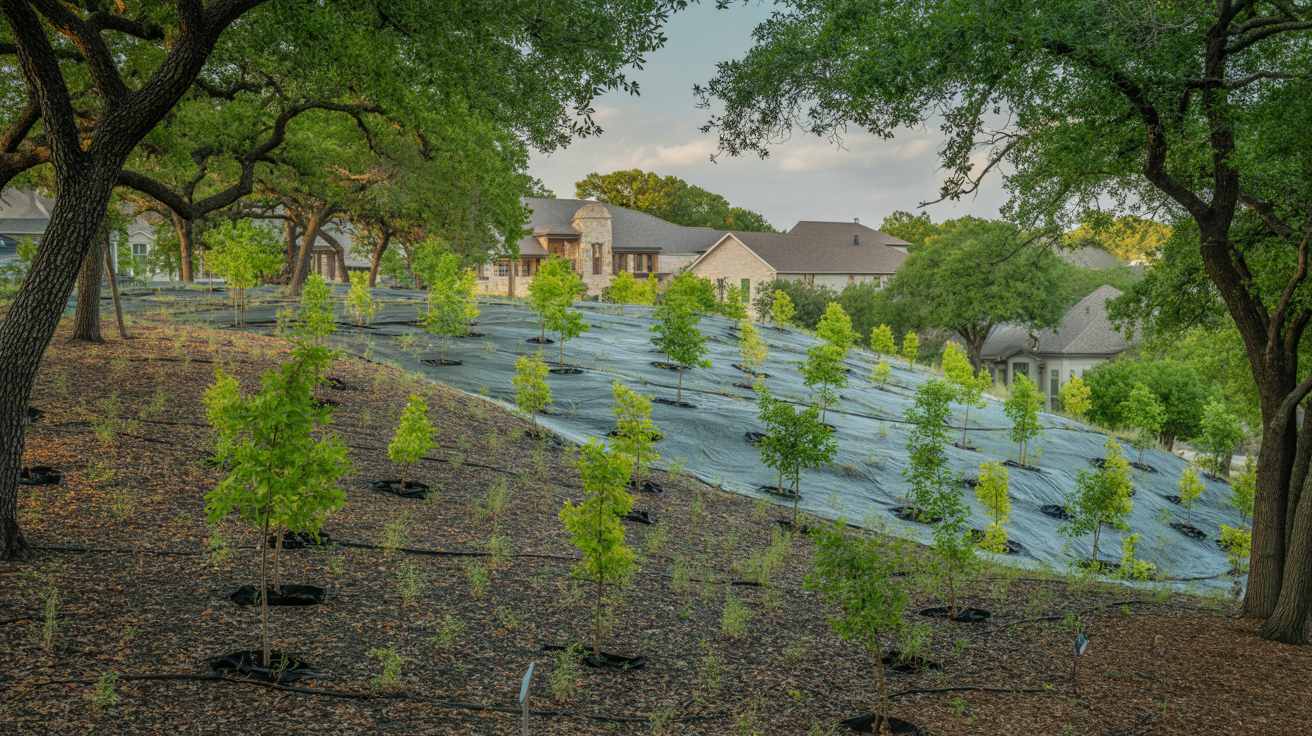
Erosion control is one of the most common problems I address through tree planting. If you've got slopes on your property, water running off during heavy rains will cut channels and wash away soil. Left unchecked, this can undermine structures, create gullies, and deposit sediment in unwanted locations. Tree roots bind soil particles together and create a reinforced structure that resists erosion. The canopy breaks the force of rainfall before it hits the ground. Together, these effects stabilize slopes and protect your investment.
Wind protection matters more than many Central Texas property owners realize. Strong winds increase evaporation, damage structures, make outdoor spaces uncomfortable, and stress other plants. Strategic placement of trees creates windbreaks that reduce wind speed. Evergreens work well for year-round wind protection. Dense deciduous trees provide seasonal protection while allowing winter sun to reach structures when you want solar gain for heating.
Privacy screening is increasingly important as properties get subdivided and neighborhoods get denser. Trees create natural barriers that block views without the stark appearance of fences or walls. The key is selecting species with dense growth habits and planting them at appropriate spacing. I typically use a mix of evergreens and deciduous trees to create year-round screening with visual interest.
Long-Term Care and Maintenance for Tree Survival
Planting trees is just the beginning. What happens during the first three years determines whether your trees thrive or struggle for the rest of their lives. I've seen too many situations where property owners invested in good trees, planted them correctly, and then neglected follow-up care. The result is poor survival rates and weak trees that never reach their potential.
Watering during establishment is critical. Newly planted trees need consistent moisture while their root systems expand into the surrounding soil. In Central Texas summers, that typically means deep watering once or twice weekly depending on rainfall, soil type, and tree species. I emphasize deep watering because you want to encourage roots to grow downward where they'll find moisture during dry periods. Shallow, frequent watering creates shallow root systems that make trees vulnerable to drought stress.
Mulching provides multiple benefits that significantly improve tree survival and growth. A layer of organic mulch around the base of your trees conserves moisture by reducing evaporation, moderates soil temperature, suppresses weeds that compete for water and nutrients, and gradually breaks down to improve soil quality. I recommend a three to four inch layer of mulch extending out to the tree's drip line, but keep the mulch pulled back from direct contact with the trunk to prevent rot and pest problems.
Protecting Your Investment from Common Threats
Wildlife damage can kill young trees quickly. Deer browse on foliage and rub antlers on trunks, rabbits chew bark, and rodents can girdle trees by eating bark all the way around the base. The specific threats vary by location, but protection measures are straightforward. Tree guards or wire cages around the trunk prevent browsing and rubbing damage. Fencing around the planting area provides broader protection if you're dealing with significant deer pressure. These protections can be removed once trees are established and large enough that wildlife damage won't threaten survival.
Pest and disease management starts with selecting healthy trees and species appropriate for your site. Stressed trees are vulnerable to insect attacks and disease. Trees growing in conditions they're adapted to have natural resistance and recovery ability. That said, you need to monitor for problems and address them early. I walk properties regularly with clients during the growing season, looking for signs of stress, unusual insect activity, or disease symptoms. Early intervention is far more effective than trying to save a tree after problems become severe.
Structural pruning during the early years shapes how your trees grow and determines their long-term form and stability. Proper pruning removes competing leaders, eliminates branches growing at bad angles, and develops good branch spacing. This work prevents problems before they develop rather than trying to correct them years later. Trees with good structure are more resilient during storms, live longer, and look better throughout their lives.
Common Tree Planting Mistakes and How to Avoid Them
After twenty years working on properties throughout Central Texas and other regions, I've seen the same mistakes repeated over and over. Understanding these common errors helps you avoid them in your own projects.
Planting trees too deep is probably the most common mistake I encounter. When trees are planted deeper than they were originally growing, several problems develop. The root flare gets buried, which can lead to rot. Roots don't get adequate oxygen. The tree becomes structurally unstable because it never develops proper root anchorage. These problems might not show up for several years, but they compromise the tree's long-term health and survival. Always locate the root flare where the trunk starts to widen at the base and keep that at or slightly above the final grade.
Choosing the wrong species for the site conditions sets your trees up for failure from day one. A tree that prefers moist, rich soil won't thrive in rocky, dry conditions no matter how much you water it. A sun-loving species planted in shade will grow slowly with poor form. Species that aren't cold hardy will suffer damage during our occasional hard freezes. I always emphasize matching species to site conditions rather than trying to force conditions to match species preferences.
Planning Failures That Cause Long-Term Problems
Inadequate spacing is a mistake that doesn't show up immediately but creates serious issues as trees mature. People see small trees in containers and don't visualize their mature size. They plant too close to structures, too close to each other, or too close to underground utilities. Years later, roots damage foundations, trees crowd each other and develop poor form, or you're forced to remove trees because they're interfering with power lines or sewer systems. I always map out mature tree sizes during the planning phase to ensure adequate spacing for long-term growth.
Neglecting site preparation saves time during planting but costs you in poor establishment and slow growth. Competing vegetation, compacted soil, poor drainage, and inadequate soil volume all limit tree success. Taking time to properly prepare the site before planting delivers better results than trying to compensate with maintenance later. On commercial and residential projects with Earth in Motion, we consider site preparation essential groundwork that makes everything else possible.
Ignoring ongoing maintenance is perhaps the most frustrating mistake because it wastes the entire initial investment. Trees need care during establishment, not just on planting day. Watering, mulching, protection from pests and wildlife, and monitoring for problems aren't optional extras. They're essential tasks that determine whether your trees survive and thrive. I work with property owners to develop realistic maintenance plans that fit their capabilities and ensure their trees get the care they need.
The Real Factors That Drive Tree Planting Costs
When property owners ask me about tree planting costs, they're usually thinking about the purchase price of the trees themselves. That's certainly part of the equation, but it's only one component of your total investment. Understanding all the factors that influence costs helps you budget appropriately and make informed decisions about your project.
Tree size is the most obvious cost factor. Smaller saplings cost less but take longer to provide benefits like shade and erosion control. Larger, more mature trees cost considerably more but deliver immediate impact. There's a balance point that makes sense for most properties where you get trees large enough to establish well and provide reasonable near-term benefits without paying premium prices for the largest available specimens. Container size directly relates to tree size, and larger containers mean more root mass and better establishment potential.
Species selection influences costs because some trees are more readily available than others, and some are more difficult to grow in nursery conditions. Native species adapted to Central Texas conditions are usually good values because local nurseries stock them readily. Unusual or specialty species command higher prices because they're less common and may need to be sourced from distant suppliers. Fast-growing species are sometimes less expensive than slower-growing trees of the same size because they reach market size more quickly.
Site Conditions and Project Complexity
Your property's characteristics significantly impact the overall investment required for successful tree planting. Accessible, relatively flat sites with good soil are straightforward to work on. Rocky terrain, steep slopes, poor soil quality, limited access, and challenging drainage all increase the labor and materials needed to prepare sites properly and establish trees successfully. On projects with Earth in Motion, we assess site conditions carefully during the planning phase so we can develop accurate scopes of work and help clients understand what's required for their specific situations.
Site preparation requirements vary enormously depending on existing conditions. Properties with compacted soil may need deep ripping or tilling to create conditions where roots can penetrate and establish. Rocky sites might require excavation and importation of quality topsoil. Areas with poor drainage need grading modifications or drainage installations. Competing vegetation removal can range from simple hand clearing to mechanical removal of established brush. Each of these activities represents labor, equipment, and potentially materials, all of which contribute to your project's total investment.
Maintenance commitments affect your ongoing costs after initial planting. Watering during establishment requires either labor for manual watering or installation of irrigation systems. Mulching needs to be renewed periodically. Protection measures like tree guards and fencing have material costs. Monitoring for problems and addressing pest or disease issues requires time and potentially treatment costs. Some property owners handle these tasks themselves, while others prefer professional maintenance services. Either approach involves costs that should be considered in your planning.
How Earth in Motion Approaches Tree Planting Projects
When I work with clients on tree planting through Earth in Motion, we start with a comprehensive site assessment. I walk the property with the client, noting existing vegetation, soil conditions, drainage patterns, sun exposure, wind patterns, and specific problems they want to address. This assessment phase is where we identify opportunities and constraints that will shape the project plan.
We discuss goals and priorities. Are you primarily focused on erosion control? Shade and energy savings? Wildlife habitat? Privacy screening? Aesthetic enhancement? Most projects have multiple objectives, and understanding which ones matter most helps guide species selection and placement decisions. I bring my construction and land management experience to these conversations, often identifying opportunities clients hadn't considered based on what I've seen work on similar properties.
Species selection comes next, where we match trees to your specific site conditions and objectives. I recommend native species whenever possible because of their superior adaptation and lower long-term maintenance requirements. We consider mature size, growth rate, root characteristics, maintenance needs, and seasonal appearance. I provide realistic information about what to expect so clients can make informed decisions rather than discoveries years later when trees don't perform as hoped.
Implementation and Follow-Through
Proper site preparation is non-negotiable in my projects. We clear competing vegetation, address drainage issues, improve soil conditions where needed, and create the foundation for successful tree establishment. This groundwork takes time and effort, but it's what separates projects where trees thrive from those where they struggle or fail. My military background and construction experience taught me that preparation and attention to detail determine outcomes.
Planting technique follows best practices I've refined over two decades of work. Correct hole sizing, proper depth, appropriate backfill, initial watering, and mulching set trees up for success. We install protection measures when needed to guard against wildlife damage. If irrigation is part of the project, we ensure trees receive water where and when they need it most.
I work with clients to establish maintenance plans that ensure their investment continues to deliver benefits long after planting day. This might involve training property owners on proper watering and care techniques, setting up maintenance schedules, or arranging for ongoing professional services. The goal is making sure trees get what they need during the critical establishment period when their long-term success is determined.
Looking at Results Over Time
The real measure of successful tree planting isn't what happens in the first month or even the first year. It's whether trees survive, establish strong root systems, grow vigorously, and deliver the benefits they were planted to provide over years and decades. This long-term perspective shapes everything I do with Earth in Motion.
I've worked on properties where we planted trees five, ten, or fifteen years ago, and I can see the results of proper planning and execution. Trees that were small saplings are now providing substantial shade, blocking wind, controlling erosion, and enhancing property values. Wildlife use them for habitat. Energy bills are lower. Property owners tell me how much they enjoy the transformation that trees created. Those outcomes are what I'm working toward on every project.
Conversely, I've been called to properties where previous planting efforts failed because corners were cut or maintenance was neglected. Dead trees, stunted growth, and disappointed property owners are the results of poor planning or execution. These situations reinforce why I emphasize doing things right from the beginning rather than hoping for the best and dealing with problems later.
Creating Lasting Value Through Strategic Tree Planting
Trees represent one of the best long-term investments you can make in your property. They require patience because benefits accumulate over years rather than appearing overnight, but the returns are substantial and persistent. Unlike most property improvements that deteriorate and require replacement, trees increase in value as they mature if you've selected appropriate species and planted them correctly.
Environmental benefits continue and often expand over time. Young trees sequester some carbon and provide modest cooling, but mature trees deliver these benefits at much larger scales. Root systems become more extensive and effective at erosion control. Wildlife habitat value increases as trees develop more complex structure. Water infiltration improves as root channels extend deeper and organic matter accumulates.
Economic returns likewise grow with the trees. Property value enhancement increases as trees mature. Energy savings expand as canopies provide more shade coverage. Erosion control benefits compound as root systems strengthen. The initial investment continues paying dividends year after year without additional major expenditures if you've planned and planted properly.
Your Next Steps Toward Successful Tree Planting
If you're considering tree planting on your Central Texas property, the most important decision you'll make is choosing to plan thoroughly before you start. Too many people rush into buying trees and planting them without understanding their site conditions, selecting appropriate species, or preparing properly. That approach leads to disappointing results and wasted money.
Start with honest assessment of your property conditions. Look at your soil, slopes, drainage patterns, sun exposure, and existing vegetation. Identify specific problems you want to address and benefits you want to achieve. Be realistic about your ability and willingness to provide maintenance during the establishment period. All of this information shapes what's possible and what makes sense for your situation.
Consider bringing in professional expertise during the planning phase even if you intend to do planting and maintenance yourself. The insights gained from someone with experience on similar properties can save you from costly mistakes and point you toward approaches that work. With Earth in Motion, I work with clients at whatever level of involvement makes sense for them, from comprehensive design and installation through advisory consultation on their own projects.
Focus on long-term success rather than short-term appearance. It's tempting to plant too many trees, choose species based solely on looks, or skip site preparation to save time and money. These shortcuts undermine your results and often cost more in the long run through poor survival, weak growth, and problems that develop years later. Investment in proper planning, site preparation, appropriate species selection, and establishment care delivers trees that thrive and provide benefits for decades.
Throughout my years working on construction and land development projects, I've learned that the most successful outcomes come from understanding what you're trying to achieve, planning systematically, executing carefully, and following through with needed maintenance. These principles apply whether you're building custom ponds, managing site drainage, or implementing comprehensive landscaping. Tree planting represents an opportunity to invest in your property's long-term value while contributing to environmental quality and community well-being, and Earth in Motion brings the experience and commitment to quality that ensures your tree planting succeeds.
Frequently Asked Questions About Tree Planting in Central Texas
What factors determine the cost of a tree planting project on my property?
The investment required for tree planting depends on several key factors that I evaluate during our initial site assessment with Earth in Motion. Tree size is the most obvious factor - smaller saplings cost less but take longer to provide benefits like shade and erosion control, while larger mature trees deliver immediate impact at higher prices. Your property's specific conditions significantly influence costs, including soil quality, terrain difficulty, accessibility, and existing vegetation that needs clearing. Site preparation requirements vary enormously - rocky terrain may need excavation and imported topsoil, while compacted soil requires deep ripping for proper root establishment. Species selection also affects pricing, as native Central Texas trees like live oaks and cedar elms are typically more readily available than specialty species. Finally, the complexity of your project goals, whether you need erosion control on slopes, privacy screening, or comprehensive landscape transformation, shapes the scope and investment required for long-term success.
Which tree species work best for Central Texas climate and soil conditions?
Through my twenty years with Earth in Motion working throughout Central Texas, I've found that native species consistently outperform non-native trees in our challenging climate. Live oaks are exceptional for their longevity, drought tolerance, and broad canopies that provide excellent shade and cooling. Cedar elms adapt well to our clay soils and provide reliable growth with minimal maintenance. For wetter areas on properties, bald cypress trees thrive and offer unique seasonal beauty. Texas red oaks deliver outstanding fall color while handling our heat and occasional freezes. In drier conditions, mesquite trees provide excellent drought tolerance and wildlife value. The key is matching species to your specific site conditions - I always recommend soil testing to understand pH, drainage characteristics, and composition before making final selections. This approach ensures your trees establish quickly, require less ongoing maintenance, and handle the stress of our triple-digit summers and periodic droughts that define Central Texas weather patterns.
How do you address common property problems like erosion and heat management through strategic tree placement?
Strategic tree placement is one of the most powerful tools I use with Earth in Motion to solve real property challenges that would otherwise require expensive engineered solutions. For erosion control on slopes, I select trees with aggressive root systems that bind soil particles together while their canopies break the force of rainfall before it hits the ground. This approach has stopped erosion problems and actually rebuilt soil structure over time on numerous Central Texas properties. For heat management around Austin and surrounding areas, I map out sun patterns and place trees to shade structures and outdoor living areas, often reducing temperatures by ten degrees during summer afternoons. This natural cooling significantly cuts air conditioning costs and makes properties more comfortable. Trees also create effective windbreaks that reduce heating costs in winter while providing privacy screening that eliminates the need for fences or walls. The key is understanding your specific property's drainage patterns, sun exposure, and problem areas during my initial assessment, then positioning the right species in locations where they'll deliver maximum benefit for your particular challenges.
What maintenance is required during the first few years to ensure tree survival and growth?
The first three years after planting determine whether your trees thrive for decades or struggle throughout their lives, which is why I work with Earth in Motion clients to establish comprehensive maintenance plans. Consistent watering during establishment is critical - newly planted trees need deep watering once or twice weekly depending on our Central Texas rainfall, encouraging roots to grow downward where they'll find moisture during dry periods. Proper mulching provides multiple benefits including moisture conservation, temperature moderation, and weed suppression, with a three to four inch layer extending to the drip line but pulled back from the trunk. Protection from wildlife damage is essential, as deer, rabbits, and rodents can kill young trees quickly - tree guards and fencing prevent browsing and bark damage until trees are established. Regular monitoring for pest and disease issues allows early intervention, far more effective than trying to save stressed trees later. Structural pruning during early years shapes long-term form and stability, removing competing leaders and developing good branch spacing. I provide training on these maintenance techniques or arrange professional services, ensuring your investment receives the care needed for long-term success.
How do you ensure tree planting projects deliver long-term value and environmental benefits?
Long-term success requires comprehensive planning and execution that I've refined over two decades with Earth in Motion working on properties throughout Central Texas and beyond. The process starts with thorough site assessment, where I evaluate soil conditions, drainage patterns, sun exposure, and specific problems you want to address, then match appropriate native species to these conditions rather than forcing unsuitable trees into challenging environments. Proper site preparation is non-negotiable - clearing competing vegetation, addressing drainage issues, improving soil conditions, and creating the foundation for successful establishment. This groundwork separates projects where trees thrive from those where they struggle or fail. My planting techniques follow best practices for hole sizing, depth, backfill, and initial care that set trees up for decades of growth. The real measure isn't first-year appearance but whether trees develop strong root systems, grow vigorously, and deliver intended benefits over time. I've returned to properties where we planted trees ten or fifteen years ago to see substantial shade, effective erosion control, enhanced property values, and satisfied clients who continue enjoying the transformation. This long-term perspective shapes every decision from species selection through maintenance planning, ensuring your investment continues delivering environmental and economic returns for decades.
Hire Us